Most of the pest calls we get come in after the plant already looks bad. An arborvitae has gone brown on one side. An azalea that was fine in May looks washed out in July. A big ash has thin branches at the top that never leafed out.
By then the insect has usually been working for weeks or longer, and in a few cases for a couple of years. The useful skill is not knowing every bug by name. It is knowing what each kind of damage looks like, so you can tell the difference between a problem that needs attention this week and one that can wait.
This is a walk through the pests we actually run into on Eastern Shore properties, and what each one leaves behind. All of the photos here come from university and government research collections, which is why they are sharper than anything we would get holding a phone up to a tree. Credits are at the bottom.
Start With the Borers, Because They Hide
Borers are beetles whose larvae feed under the bark instead of on the leaves. That one fact drives everything about how they are found and treated.
Leaf-feeding insects show you the damage while they are doing it. Borers do not. The larvae spend months chewing through the layer just under the bark, and the tree looks close to normal until enough of that layer is destroyed that water stops moving up the trunk. By the time the canopy thins, the damage is done and cannot be undone.
So with borers you are reading signs on the bark rather than watching leaves. The most reliable one is the hole the adult beetle cuts on its way out.
What the Shape of the Hole Tells You
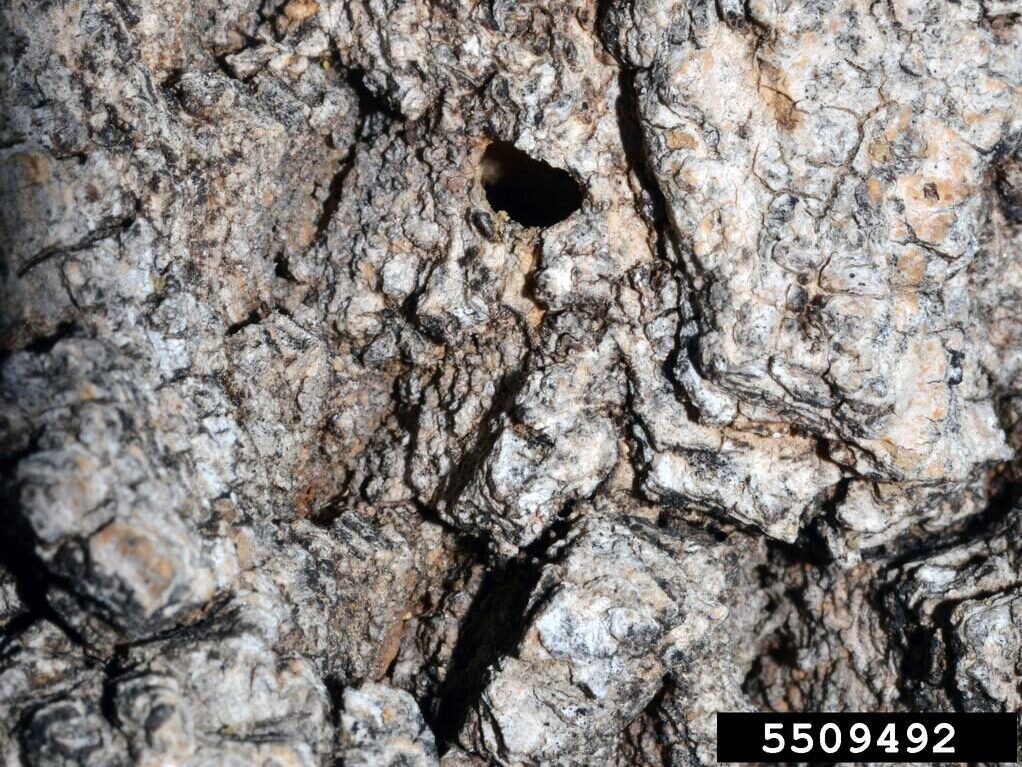
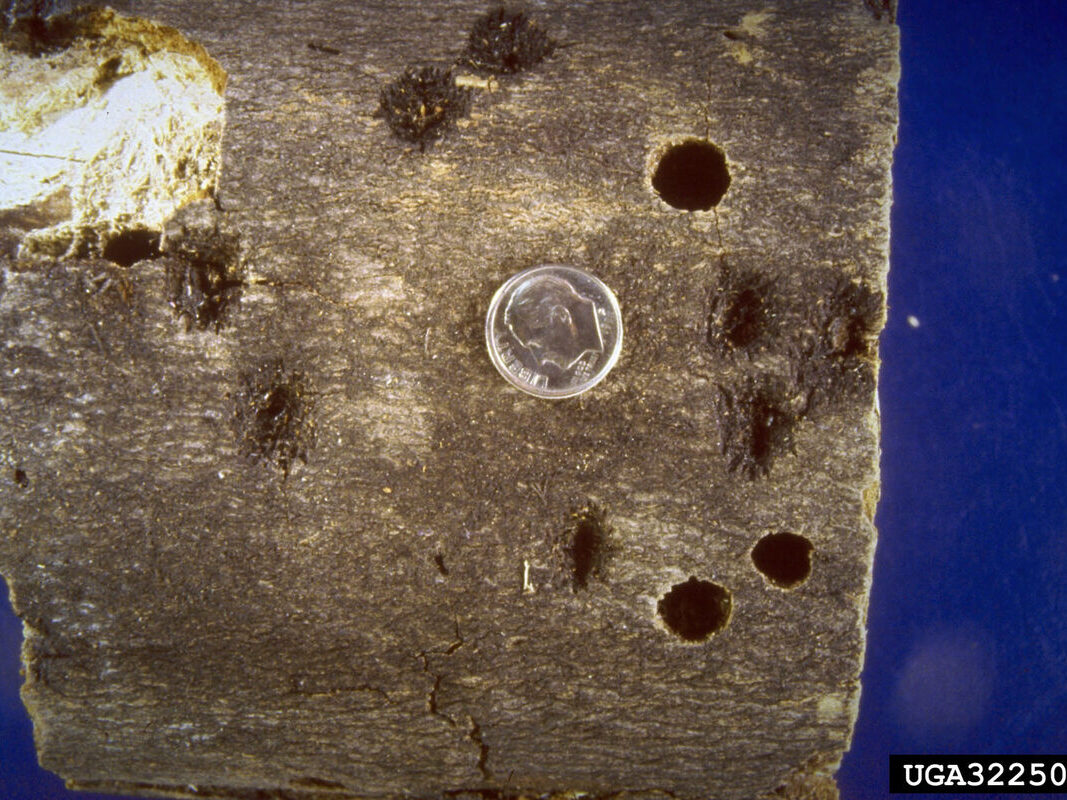
Adult borers chew their way out through the bark when they emerge. The hole they leave takes the shape of the beetle’s body, and different beetle families are shaped differently. That makes the hole a real identification, not a guess.
William M. Ciesla, Forest Health Management International, Bugwood.org, CC BY 3.0 US · Resized for web and re-compressed. Cropped to 4:3. Not otherwise altered.
E. Richard Hoebeke, Cornell University, Bugwood.org, CC BY 3.0 US · Resized for web and re-compressed. Cropped to 4:3. Not otherwise altered.
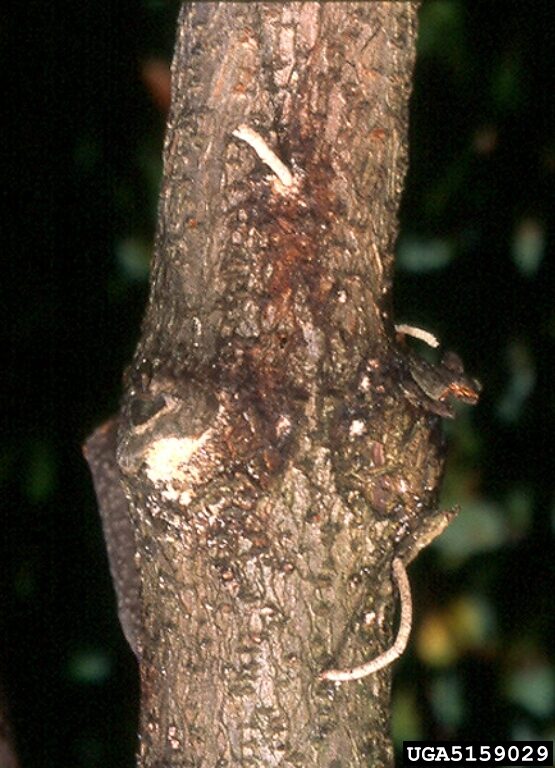
There is a third pattern, and it does not look like a hole at all.
J.R. Baker & S.B. Bambara, North Carolina State University, Bugwood.org, CC BY 3.0 US · Resized for web and re-compressed. Not otherwise altered.
A quick summary of what you are looking at:
- D-shaped hole, small means a flatheaded borer. Emerald ash borer on ash, bronze birch borer on birch.
- Round hole, larger means a roundheaded borer, one of the longhorned beetles.
- Sawdust toothpicks mean ambrosia beetles, usually in a young or already struggling tree.
- Holes low on the trunk with gummy sawdust around them are usually a clearwing moth borer instead of a beetle. Dogwood borer and peachtree borer are the ones we see, and they work near the base rather than up in the canopy.
One note on the round holes. Asian longhorned beetle is a quarantine pest that attacks maple, birch, willow, elm, and horsechestnut, and it has not been found in Maryland. Eradication work is going on in Massachusetts, New York, Ohio, and South Carolina. It is not something to worry about here. Still, if you ever find a round exit hole about three eighths of an inch across in a maple, along with pitted egg sites chewed into the bark, that is the one thing on this page to report to the Maryland Department of Agriculture rather than treat.
The Other Signs to Check
Exit holes confirm an infestation, but they also mean at least one generation has already completed. Several other signs show up earlier.
Thinning that starts at the top. Most borers work downward. A tree that is thin and bare in the upper third while the lower branches still look full is a borer pattern. Drought and root problems tend to affect the whole crown more evenly.
Sprouts coming out of the trunk and lower limbs. When a tree loses its canopy it tries to replace it from dormant buds low down. Arborists call these epicormic sprouts. A trunk that suddenly grows a beard of small shoots is a tree in trouble.
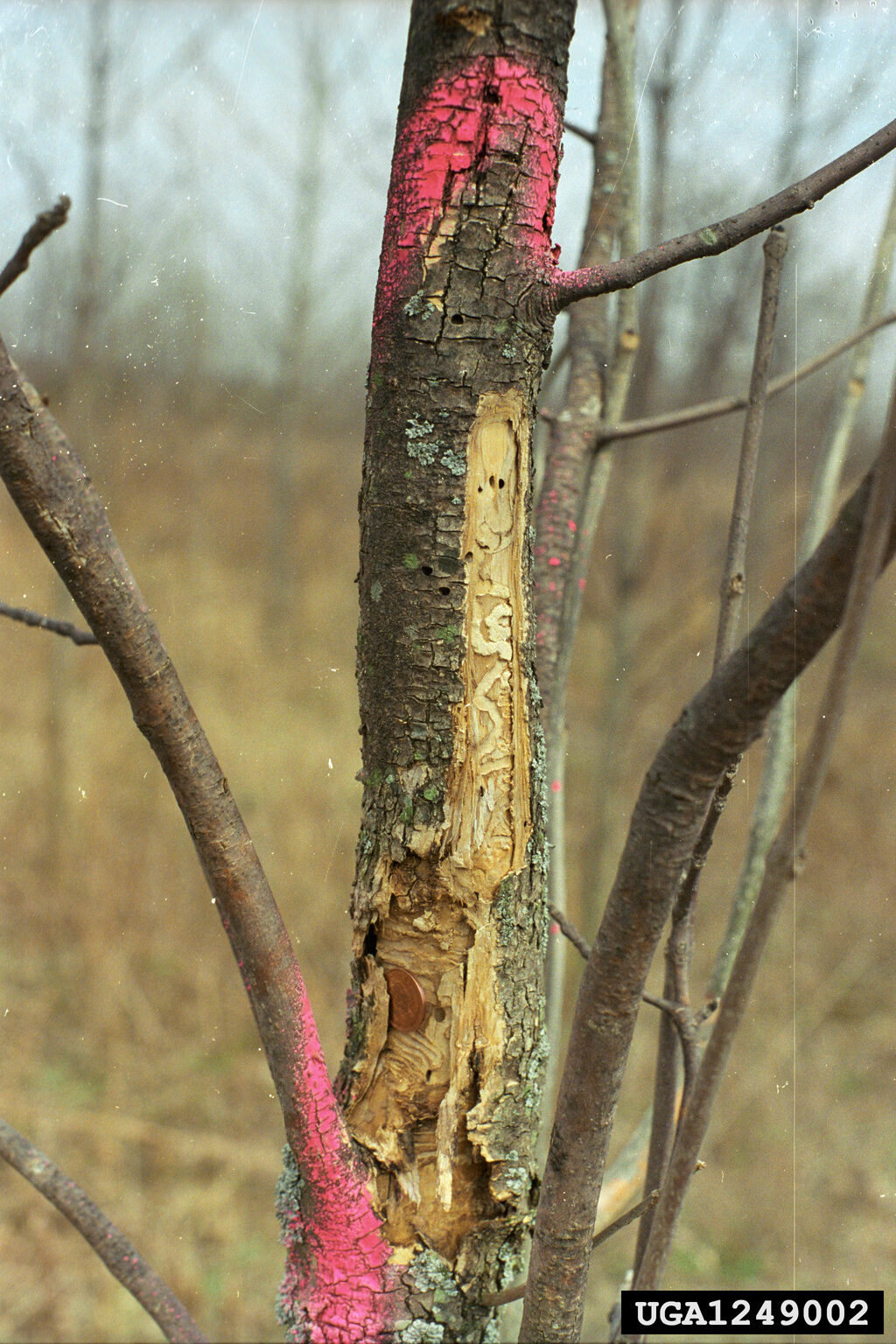
Bark splitting vertically. The larval tunnels underneath push the bark apart and it cracks along the grain.
Woodpecker work. Woodpeckers find borer larvae before people do. Patches where the outer bark has been flaked away leaving lighter wood showing through, often high in the tree, are a strong early signal. On ash this gets called blonding.
Troy Kimoto, Canadian Food Inspection Agency, Bugwood.org, CC BY 3.0 US · Resized for web and re-compressed. Not otherwise altered.
Emerald Ash Borer
Emerald ash borer is established across Maryland, Delaware, and Virginia. An untreated ash in this area will eventually be killed by it. That is a blunt thing to say, but it is where things stand, and it changes how you should think about any ash on your property.
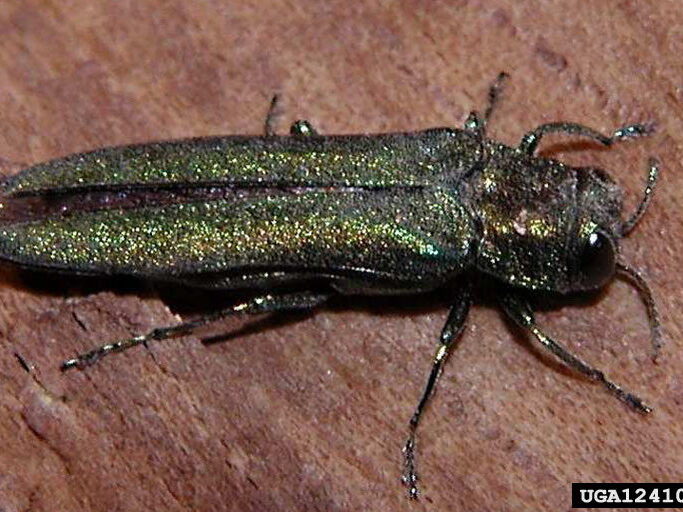
David Cappaert, Bugwood.org, CC BY 3.0 US · Resized for web and re-compressed. Cropped to 4:3. Not otherwise altered.
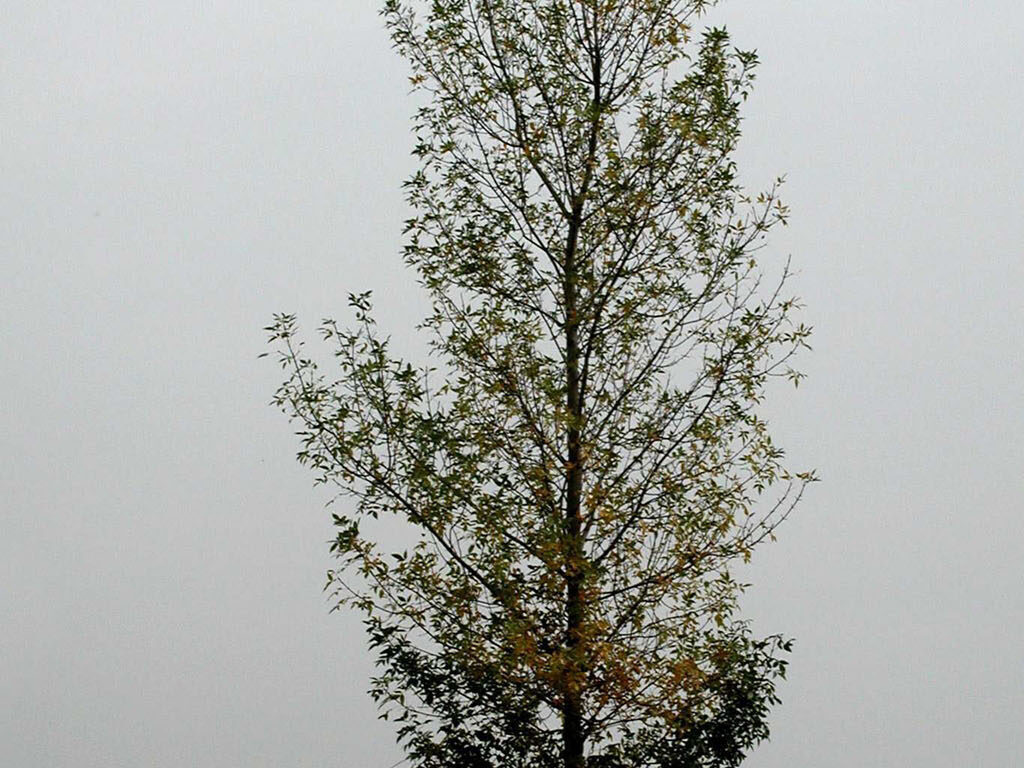
David Cappaert, Bugwood.org, CC BY 3.0 US · Resized for web and re-compressed. Cropped to 4:3. Not otherwise altered.
What it attacks. True ash, meaning white ash, green ash, and the rest of the Fraxinus group. Mountain ash is a different tree entirely and is not a host. White fringetree can be attacked, though it is uncommon.
How to check a tree. Look at the upper canopy first for thinning and dead branch tips. Then look at the trunk and larger limbs for bark splits, sprouts, and pale flecked patches where woodpeckers have been working. D-shaped exit holes confirm it.
On timing. Treatment is effective when it starts before the tree has lost roughly a third to half of its canopy. Past that point the tree cannot move the treatment around well enough for it to help, and the decision shifts from treatment to removal. An ash that still looks healthy is the one where you have options, which is the reason to have it looked at before anything is obviously wrong.
Removal has its own timing problem. An ash killed by borers dries out and becomes brittle much faster than most hardwoods, which makes taking it down more difficult and more dangerous the longer it stands. Ash near a house, a drive, or a power line is worth deciding about early. That work runs through forestry and tree removal.
Bronze Birch Borer
Same family as emerald ash borer, same D-shaped exit hole, and the same top-down dieback. What differs is which trees it goes after.
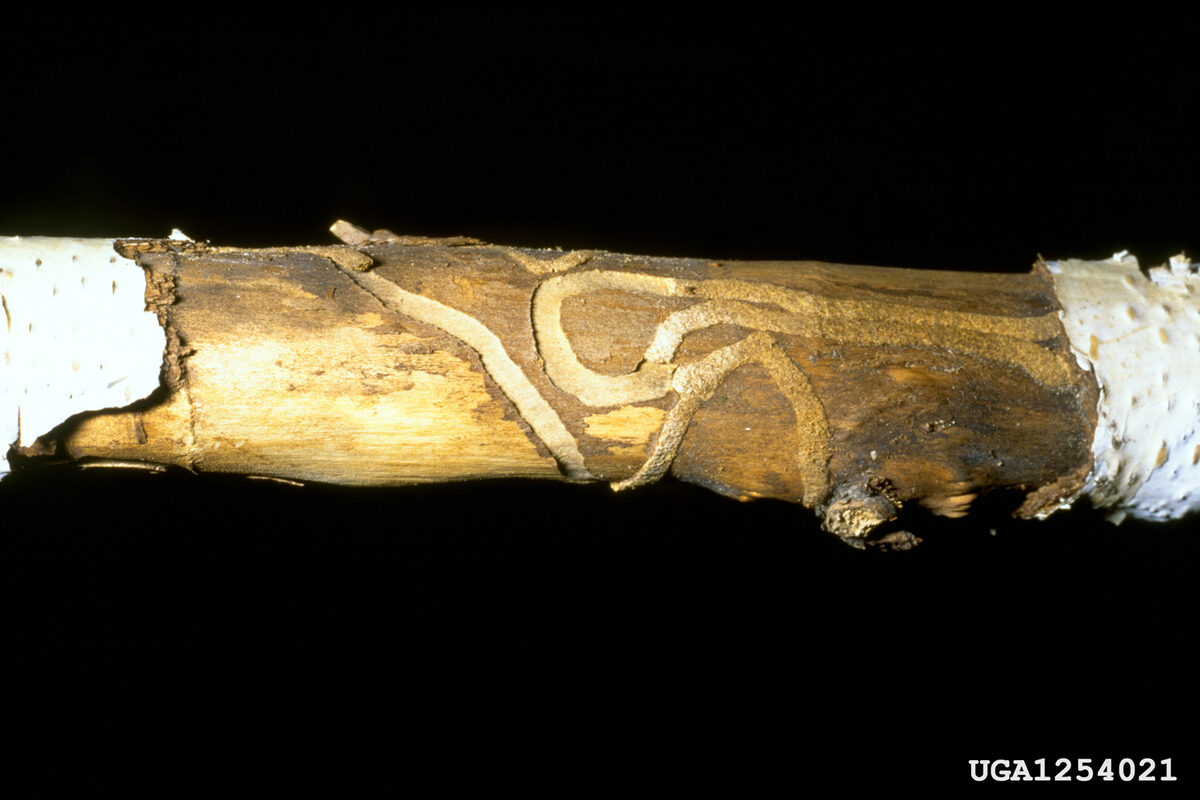
William M. Ciesla, Forest Health Management International, Bugwood.org, CC BY 3.0 US · Resized for web and re-compressed. Not otherwise altered.
The important part for anyone planting a birch here is that susceptibility varies a lot by species.
- European white birch and the white-barked ornamental birches are hit hardest. The weeping and cutleaf forms sold for their bark are the most vulnerable trees in the group.
- Paper birch and gray birch are in the middle.
- River birch is highly resistant. It is a native species with a long shared history with this beetle, and it holds up unless it is badly stressed. Most birch planted on the Shore now is river birch, often the Heritage or Dura-Heat selections, and that choice is exactly why.
Bronze birch borer also behaves like an opportunist. It goes for trees that are already struggling from drought, compacted soil, root damage, or heat. A birch planted in an open lawn with reflected heat off a driveway is under more stress than one at a woodland edge, and it is the one that gets attacked. Watering during dry spells keeps a birch out of that category. That is part of tree and shrub watering.
Bagworms
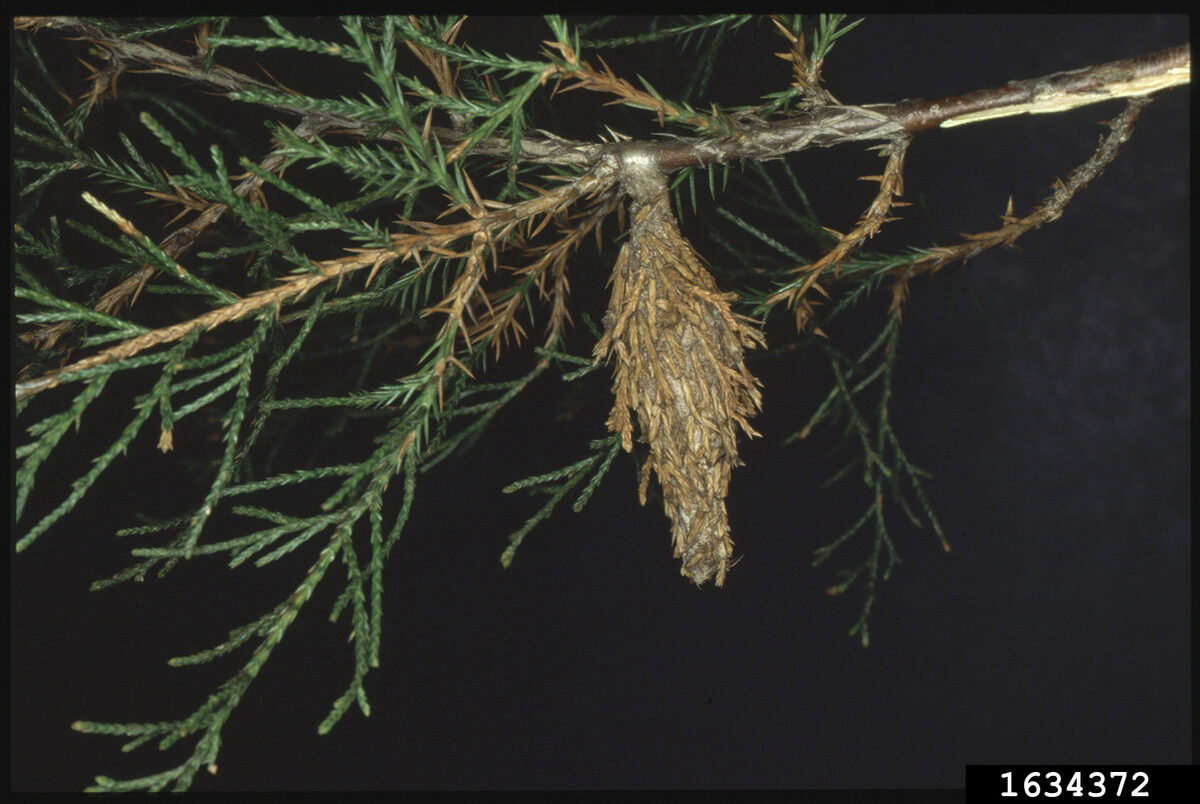
Bagworms are the pest we get called about most on evergreens, and the one where timing matters more than anything else.
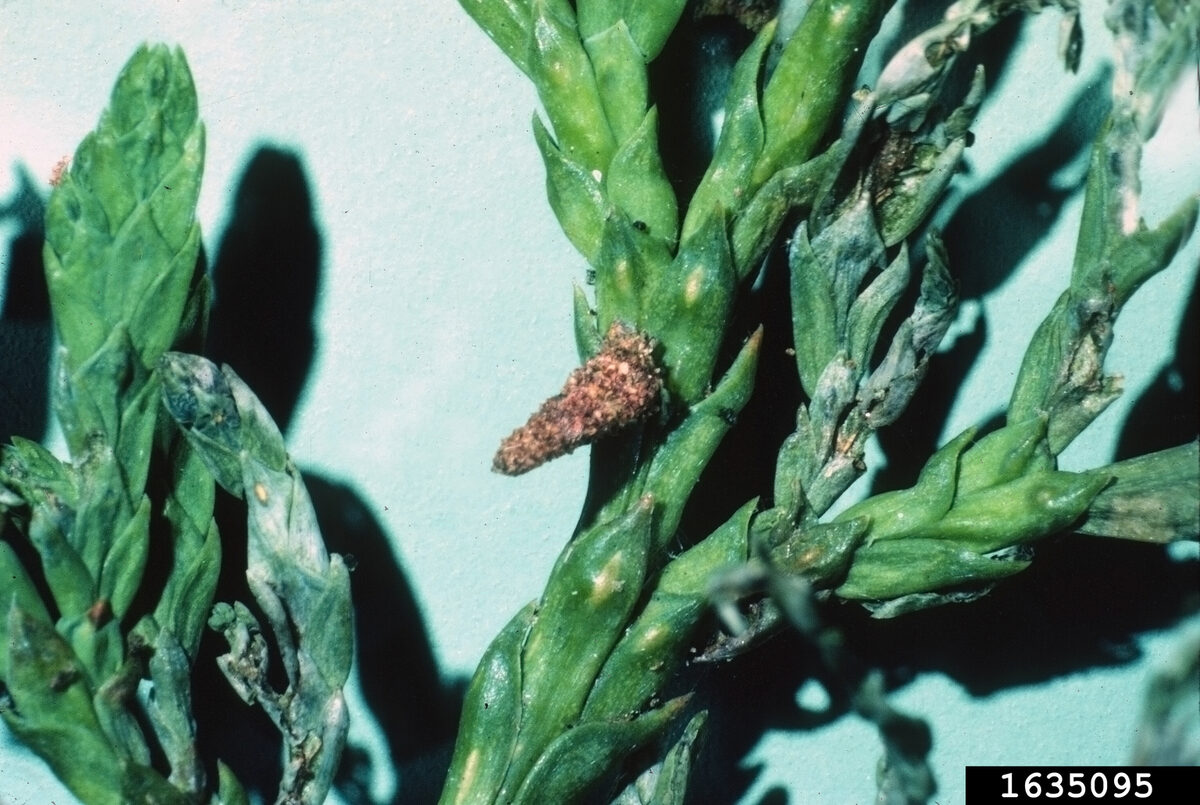
John .A. Davidson, Univ. Md, College Pk, Bugwood.org, CC BY 3.0 US · Resized for web and re-compressed. Not otherwise altered.
Penn State Department of Plant Pathology & Environmental Microbiology Archives , Penn State University, Bugwood.org, CC BY 3.0 US · Resized for web and re-compressed. Not otherwise altered.
The bag is made from the plant’s own foliage, so bagworms on juniper look like juniper and bagworms on arborvitae look like arborvitae. That camouflage is why they get missed.
Why the Shore is good for them. Warm summers, mild winters, and a landscape full of arborvitae, eastern red cedar, and juniper. Those are their preferred hosts and they are in nearly every foundation planting and screen row around here.
Why waiting on bagworms cannot be undone. Arborvitae, juniper, and most other conifers cannot regrow from bare wood. Once a branch is stripped to brown stems, it stays brown. A deciduous tree defoliated by bagworms will usually releaf the following spring. A row of arborvitae will not, and a heavy infestation left alone for two seasons can kill the planting outright. Replacing an established screen row is not a small job.
What to do and when. Eggs overwinter inside the old female bags, and they hatch here from late May into early June. That is the window. Treatment during it, including Bacillus thuringiensis, a naturally occurring soil bacterium that only affects caterpillars, works well on small larvae and does not harm bees or beneficial insects. The same product against mature bags in August does essentially nothing.
Through the winter you can pick the old bags off by hand. Every bag removed is several hundred eggs that will not hatch in your beds in June. On a small planting this alone makes a real difference.
Scale Insects
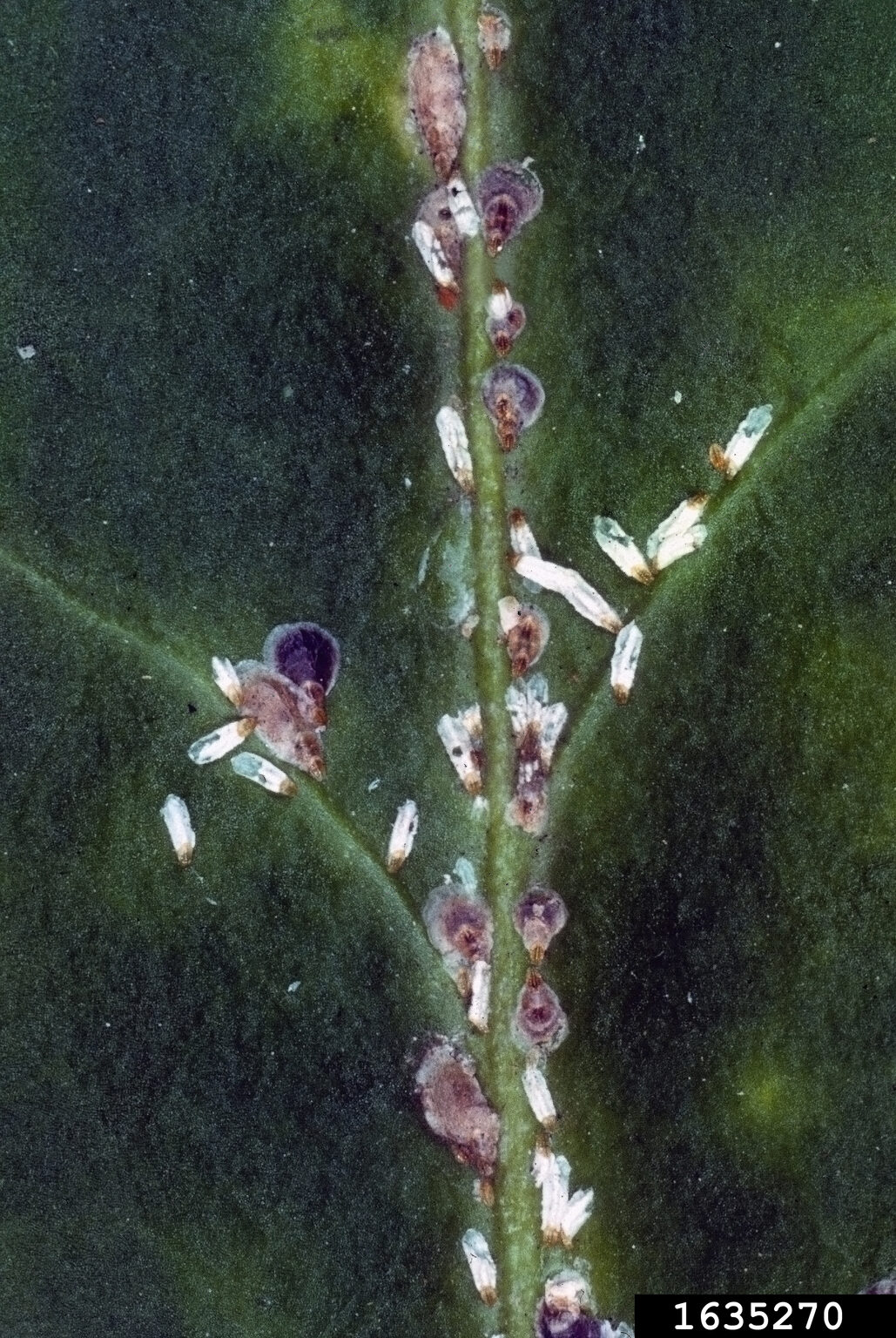
Scale insects do not look like insects. They sit still, they have no visible legs, and they are easy to take for a disease or for a rough patch of bark.
John .A. Davidson, Univ. Md, College Pk, Bugwood.org, CC BY 3.0 US · Resized for web and re-compressed. Not otherwise altered.
Scales spend most of their life fixed in one spot under a waxy cover. That cover is also what makes them hard to treat, because most sprays cannot get through it.
There are two groups worth telling apart:
- Armored scales build a separate hard cover that is not attached to their body. Euonymus scale is one. They do not produce honeydew.
- Soft scales have a waxy coating that is part of the body. They excrete honeydew, which is sugary waste, and it makes leaves and anything under the plant sticky. If a car parked under a tree keeps getting spotted, look for soft scale or aphids above it.
The treatment window. Newly hatched scales, called crawlers, are mobile and have no cover yet. That is the point at which they can be reached, and it lasts a week or two per generation. Outside of it, horticultural oil applied while plants are dormant in late winter is the other reliable approach, because it smothers rather than poisons.
Common hosts here are holly, euonymus, taxus, magnolia, and camellia. Scale is a good example of why regular inspection through the season is more useful than a spray schedule, since the window moves with the weather.
Lace Bugs
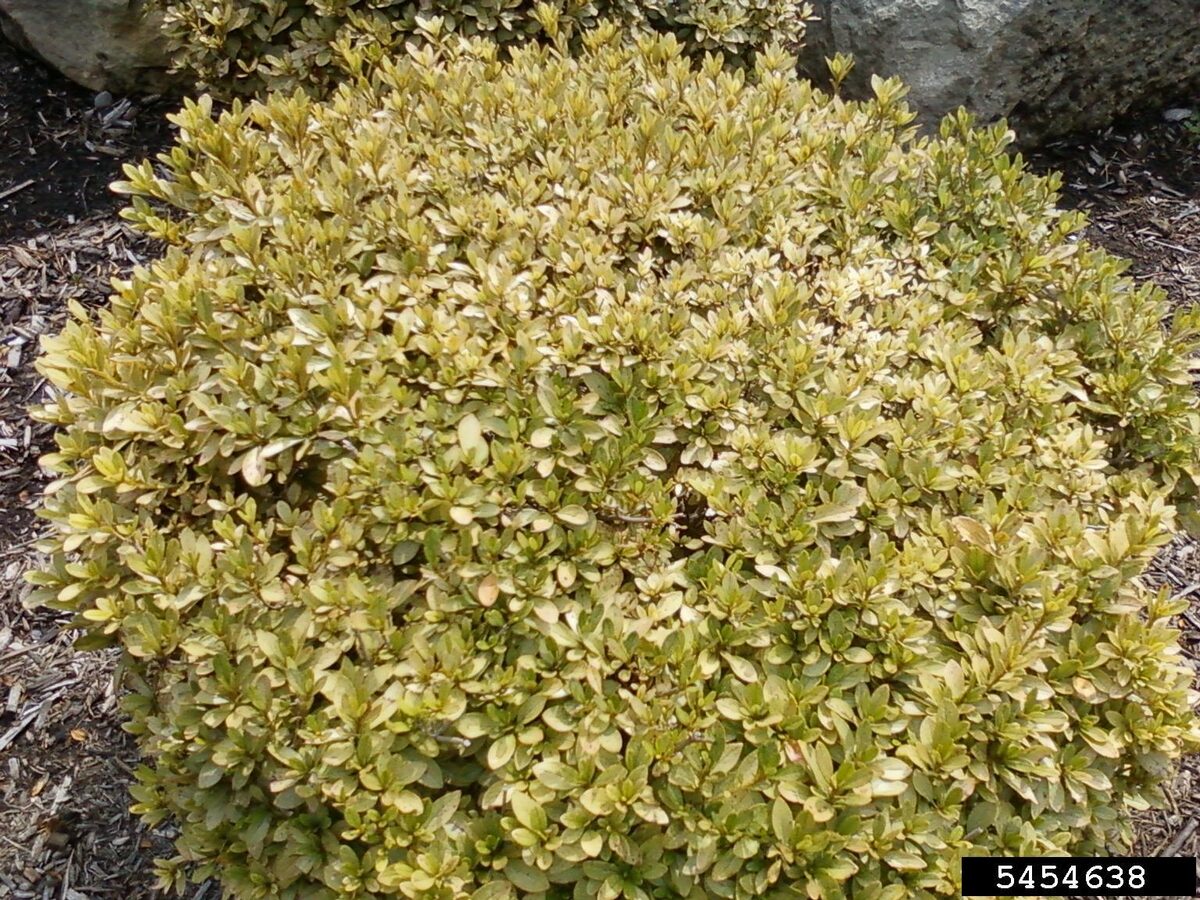
Lace bug damage looks like several other things at once. Azalea, andromeda, and hawthorn lace bugs are all chronic problems here.
Jason Sharman, Vitalitree, Bugwood.org, CC BY 3.0 US · Resized for web and re-compressed. Not otherwise altered.
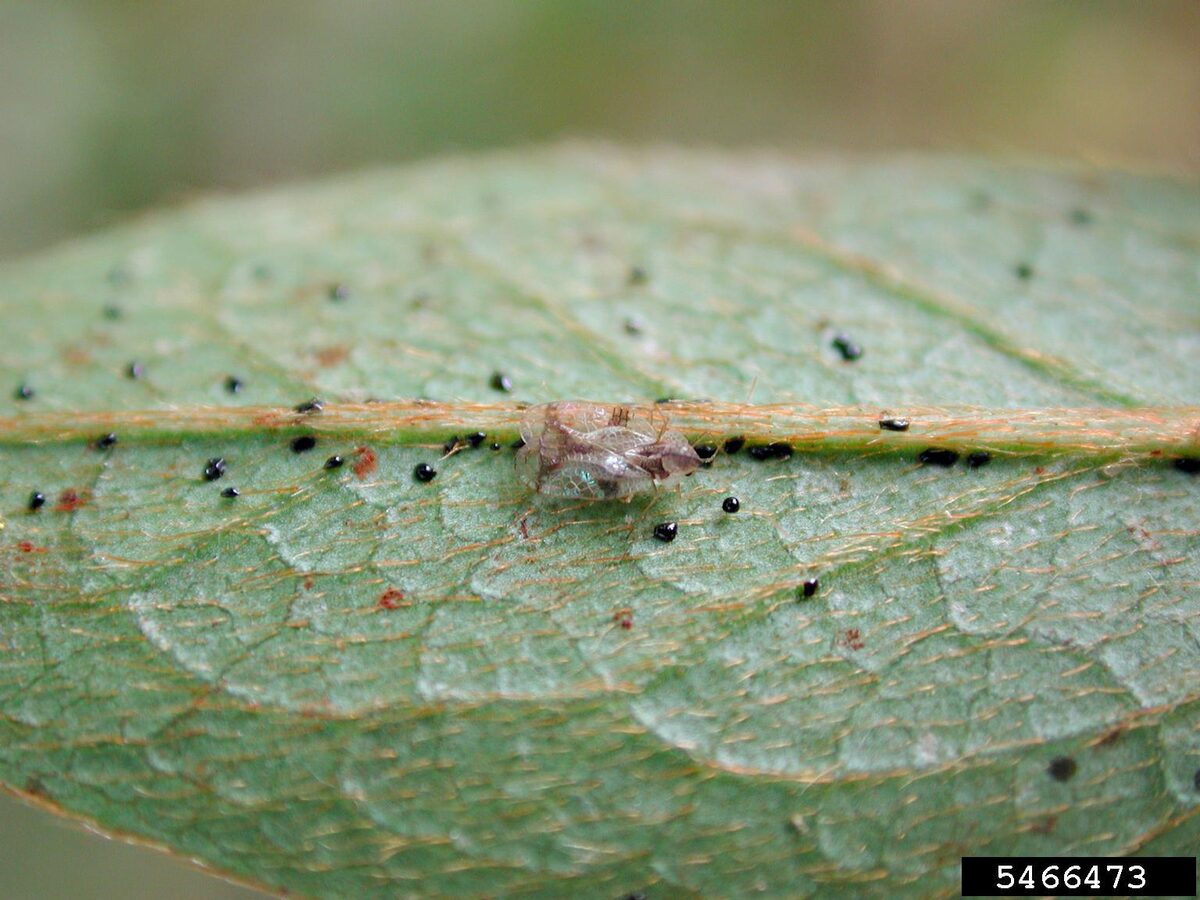
The insects themselves are on the undersides of the leaves, which is why turning a leaf over usually settles it.
Pest and Diseases Image Library (PaDIL) , Bugwood.org, CC BY 3.0 US · Resized for web and re-compressed. Not otherwise altered.
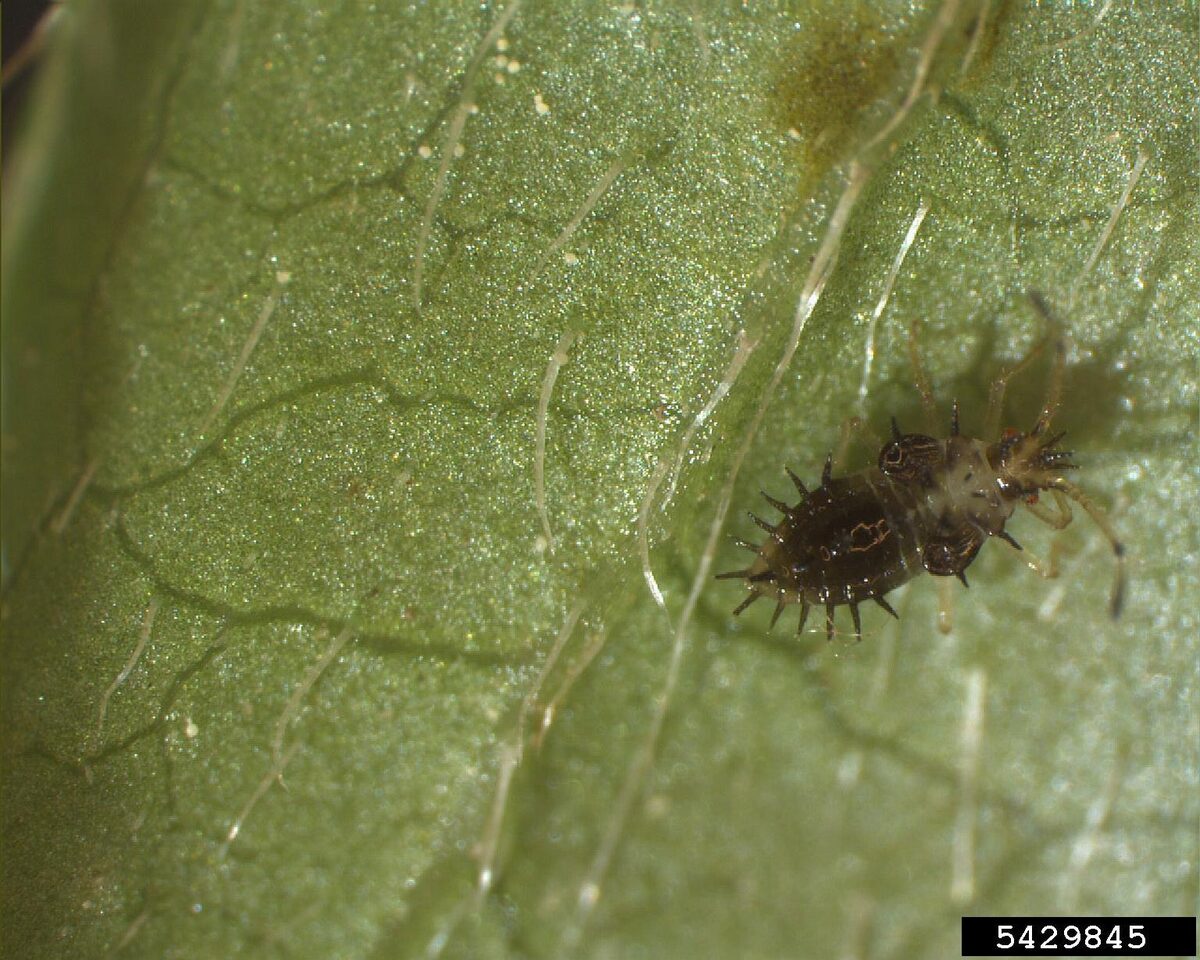
Tracy Wootten, University of Delaware, Bugwood.org, CC BY 3.0 US · Resized for web and re-compressed. Not otherwise altered.
Sun makes it worse. Azaleas in full sun get hit far harder than the same variety in shade. If you have one azalea that always looks rough and others nearby that are fine, check where the sun falls before assuming the plant is a bad one.
Lace bugs run several generations a season here, so damage builds through the summer. The bleached leaves never turn green again, because those cells are dead. New growth comes in clean once the insects are controlled, and the plant looks normal again after a flush or two.
Spider Mites
Spider mite damage looks similar enough to lace bug damage that the two get confused constantly. Both leave a fine pale speckling on the leaves. Telling them apart takes ten seconds if you know where to look.
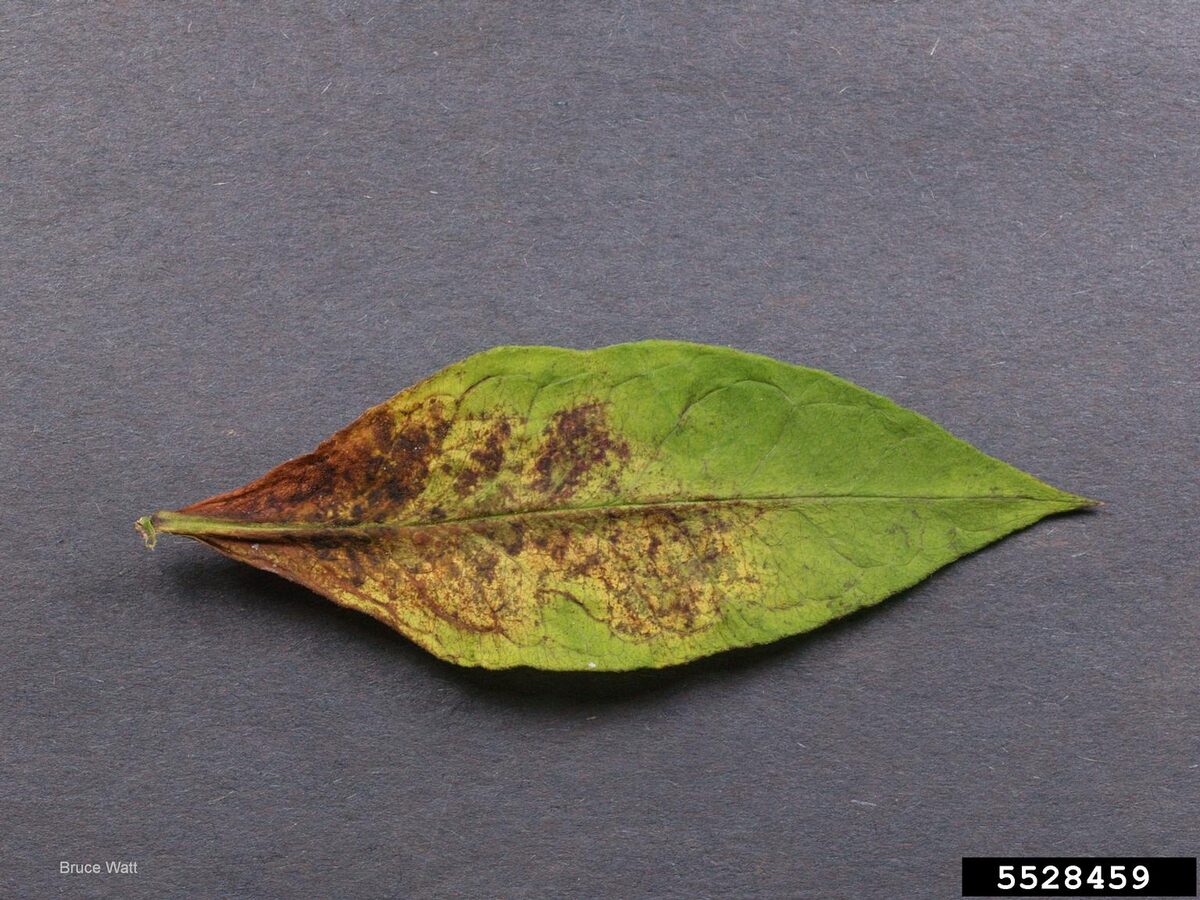
Bruce Watt, University of Maine, Bugwood.org, CC BY 3.0 US · Resized for web and re-compressed. Not otherwise altered.
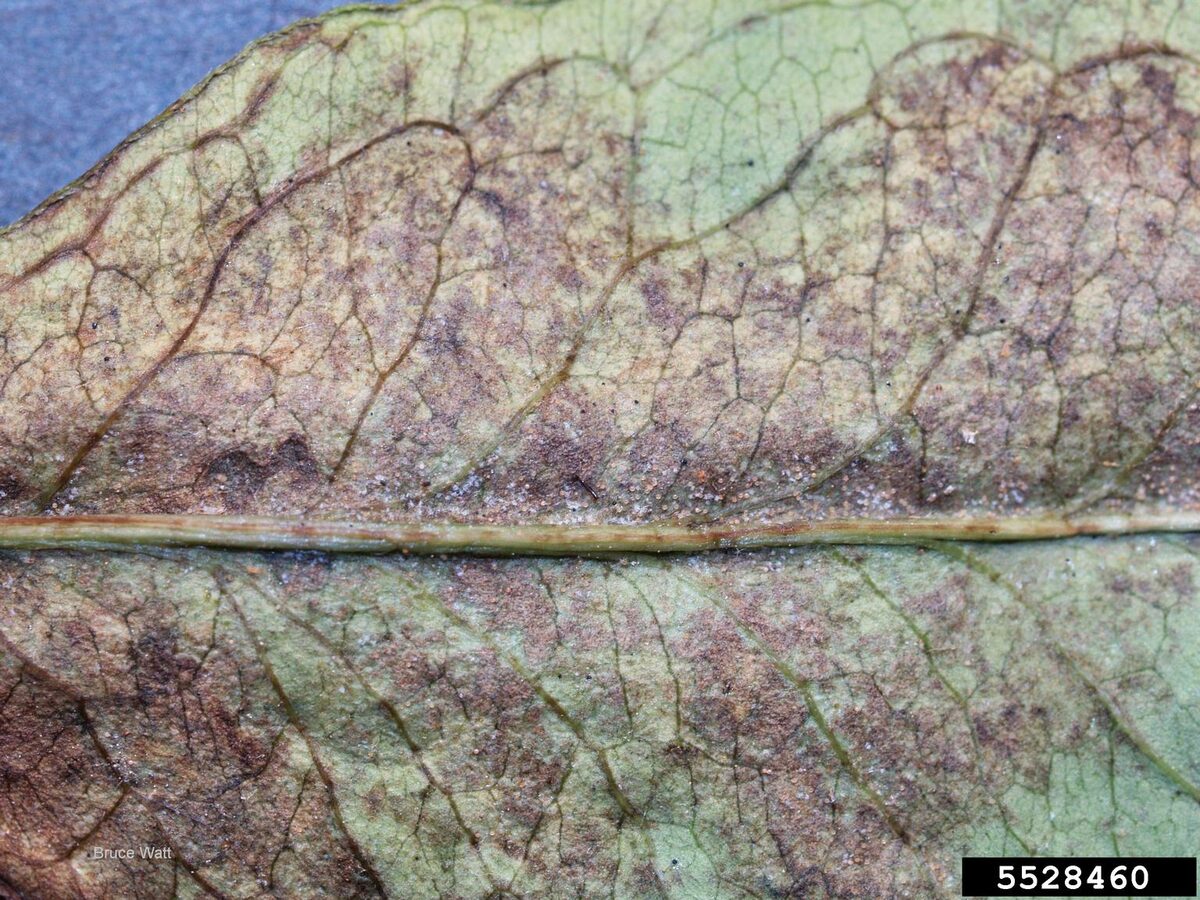
Bruce Watt, University of Maine, Bugwood.org, CC BY 3.0 US · Resized for web and re-compressed. Not otherwise altered.
How to separate the two. Turn a leaf over. Distinct shiny black spots stuck to the surface mean lace bugs. No black spots, but a gritty look, faint webbing in the leaf junctions, and specks that move, mean mites.
The paper test. Hold a sheet of white paper under a branch and tap the branch sharply against it. Mites fall off and show up as slow-moving specks the size of ground pepper. If the specks are red, that is common and normal for several species.
Which mite, and when. This matters more than people expect, because the two groups are active at opposite times of year.
- Two-spotted spider mite is a hot weather pest. It builds through July and August, worst in dry spells and on plants against a wall or driveway.
- Spruce spider mite is a cool weather pest and works in spring and fall on arborvitae, spruce, juniper, and other conifers. It usually goes quiet in midsummer.
That second one causes real confusion. An arborvitae that browns off in spring is often blamed on winter burn when it is actually mite feeding, and treating for mites in July when the pest is a spruce spider mite accomplishes nothing.
Hot dry weather drives mite populations up quickly. So does overuse of broad-spectrum insecticide, which kills the predatory mites that would otherwise hold them down.
Aphids
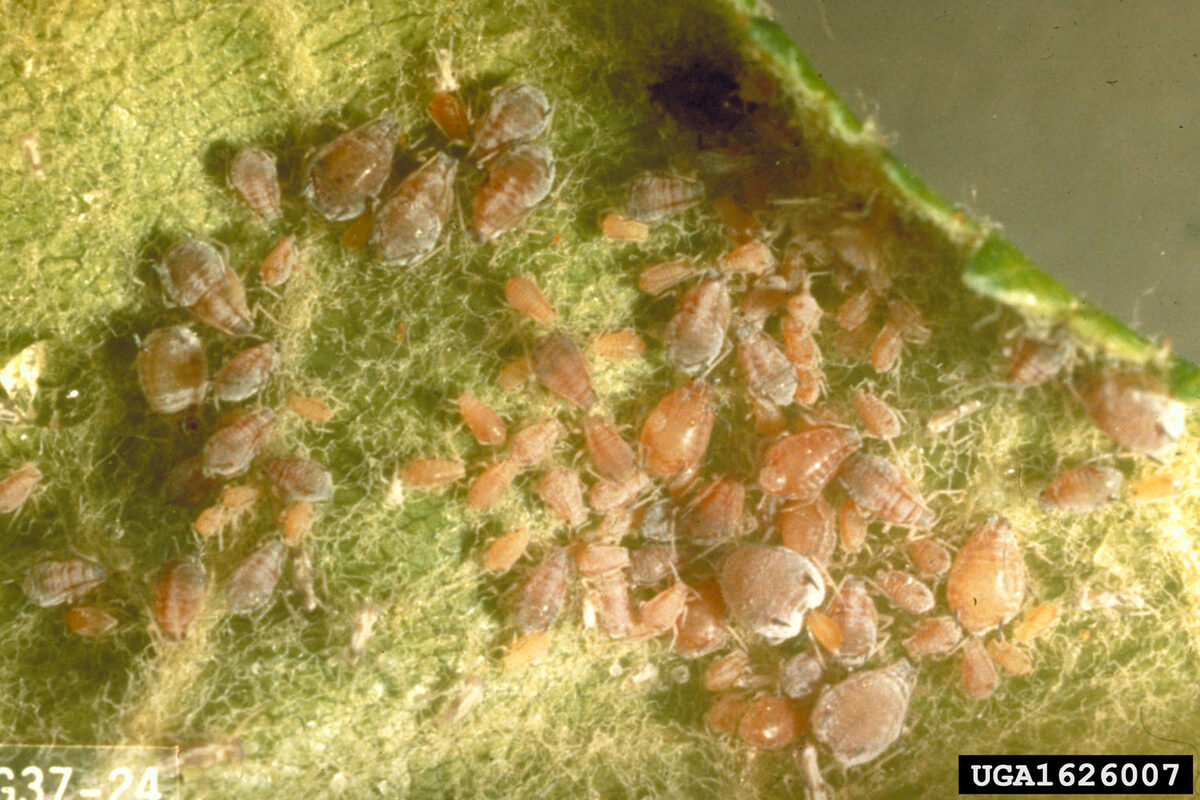
John A. Weidhass, Virginia Polytechnic Institute and State University, Bugwood.org, CC BY 3.0 US · Resized for web and re-compressed. Not otherwise altered.
Aphids feed on sap and pass the excess sugar straight through as honeydew. That honeydew is what usually gets noticed first, before anyone sees an aphid.
- Leaves and stems below the infestation feel sticky.
- A black film grows on the sticky surfaces. That is sooty mold, a fungus that lives on the honeydew rather than on the plant. It does not infect the plant, but it blocks light and looks bad.
- Ants run up and down the trunk. Ants farm aphids for the honeydew and will actively defend them from predators.
- Cars, walks, and patio furniture under the plant get spotted.
On the Shore we see aphids most on roses, crape myrtle, viburnum, ornamental cherry, and tulip poplar. Crape myrtle in particular gets a lot of sooty mold, and the complaint that comes in is almost always about the black film rather than the insect causing it.
Aphids also have a lot of natural enemies. Lady beetle larvae, lacewings, and parasitic wasps will often bring a population down on their own within a couple of weeks. A hard spray of water knocks them off and is enough for a light case on a rose. Reaching for a broad insecticide early tends to make the following month worse, because it removes the predators along with the aphids.
Japanese Beetles
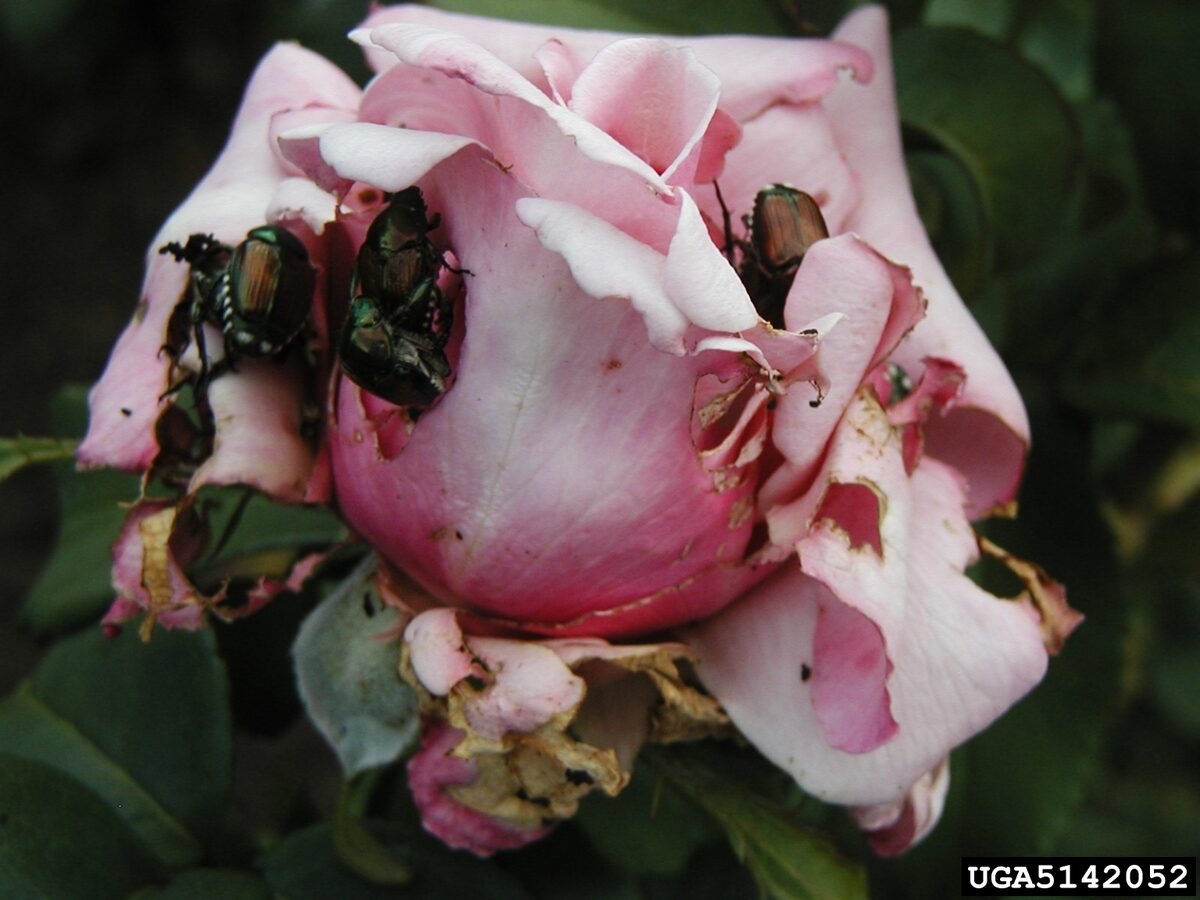
Dow Gardens , Dow Gardens, Bugwood.org, CC BY 3.0 US · Resized for web and re-compressed. Not otherwise altered.
Adults are out from late June through August. They eat the tissue between the leaf veins and leave the veins behind, which gives the leaves a lacy skeleton look that is unmistakable once you have seen it. Roses, crape myrtle, linden, Japanese maple, birch, and cherry are the ones they go for first.
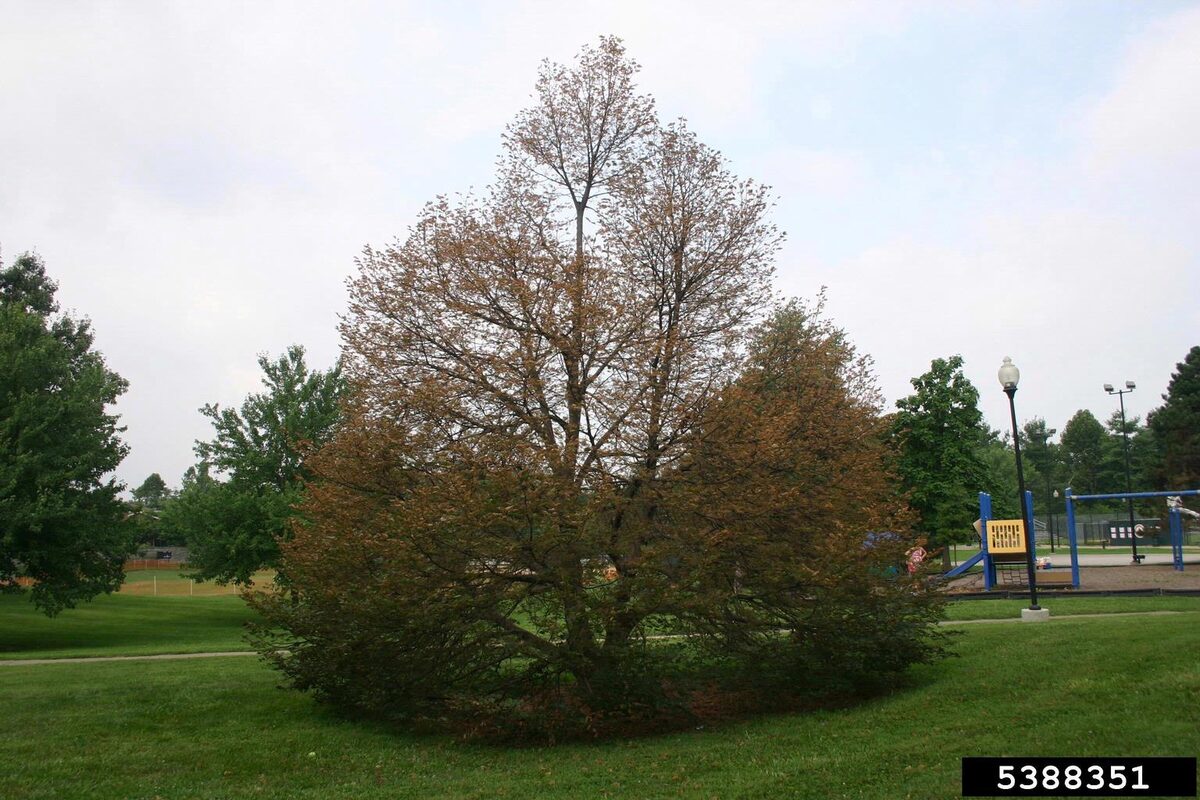
William Fountain, University of Kentucky, Bugwood.org, CC BY 3.0 US · Resized for web and re-compressed. Not otherwise altered.
On the traps. Japanese beetle traps use a scent lure that pulls beetles in from a long way off, and they catch a fraction of what they attract. Putting one in a yard reliably increases the feeding damage in that yard. If a neighbour is running one, your plants are getting the overflow.
One insect, two problems. The beetles chewing your roses in July lay eggs in your lawn in August, and those eggs become the white grubs that feed on turf roots through fall. It is one insect causing two separate problems on the same property at different times of year, which is why we treat ornamental pests and lawn care as one plan rather than two.
A Short Scouting Routine
None of this needs specialist equipment. A walk around the property every few weeks through the growing season catches nearly everything early, which is when there are still choices to make.
- Look up first. Thin spots and dead tips in the upper canopy of large trees, especially ash and birch. Most borer problems are visible here before anywhere else.
- Look at the trunk. Holes, splits, sawdust, sprouts, and flaked patches from woodpeckers.
- Turn leaves over. Almost every sucking insect lives on the underside. Black spots mean lace bugs, gritty specks mean mites, clusters of soft bodies mean aphids, hard bumps mean scale.
- Check the evergreens in late May. Specifically for small bagworm bags on arborvitae, cedar, and juniper. This one is on a calendar rather than a rotation, because the window is narrow.
- Note anything sticky. Honeydew on a walk or a car points at aphids or soft scale in whatever is overhead.
Anything that looks off but does not match one of these is worth a photo. Damage patterns are usually identifiable from a clear picture of an affected leaf, top and bottom, plus one of the whole plant.
Where We Come In
Marshall Property Management carries a Maryland Department of Agriculture Pesticide Business License (#27327) and Applicator License (#42337), which covers the treatment side of this on client properties. The more useful half of the job is the part that happens before treatment, which is correct identification and getting the timing right.
Most of the pests here have a window where control works well and a long stretch either side where the same product does very little. Bagworms in June, scale crawlers for a couple of weeks per generation, borers before the canopy thins. Properties on a year-round maintenance plan get looked at often enough that those windows are caught as a matter of routine rather than after somebody notices a plant looking rough.
If something on your property looks wrong and you cannot place it, send a photo or ask us to take a look while we are out. Getting the identification right first saves a lot of guessing later.
See also: Insect Control · Tree and Shrub Trimming · Tree and Shrub Planting · Forestry · Lawn Care
Photo Credits
Every photograph on this page comes from the Bugwood Image Database System at the University of Georgia, used under a Creative Commons Attribution 3.0 United States license. Images have been resized for the web and re-compressed. They are not otherwise altered. Each caption links to the original record, and the photographers retain their rights.
- emerald ash borer, William M. Ciesla, Forest Health Management International, Bugwood.org
- Asian longhorned beetle, E. Richard Hoebeke, Cornell University, Bugwood.org
- granulate ambrosia beetle, J.R. Baker & S.B. Bambara, North Carolina State University, Bugwood.org
- emerald ash borer, Troy Kimoto, Canadian Food Inspection Agency, Bugwood.org
- emerald ash borer, David Cappaert, Bugwood.org
- emerald ash borer, David Cappaert, Bugwood.org
- bronze birch borer, William M. Ciesla, Forest Health Management International, Bugwood.org
- evergreen bagworm, John .A. Davidson, Univ. Md, College Pk, Bugwood.org
- evergreen bagworm, Penn State Department of Plant Pathology & Environmental Microbiology Archives , Penn State University, Bugwood.org
- euonymus scale, John .A. Davidson, Univ. Md, College Pk, Bugwood.org
- azalea lace bug, Jason Sharman, Vitalitree, Bugwood.org
- azalea lace bug, Pest and Diseases Image Library (PaDIL) , Bugwood.org
- azalea lace bug, Tracy Wootten, University of Delaware, Bugwood.org
- twospotted spider mite, Bruce Watt, University of Maine, Bugwood.org
- twospotted spider mite, Bruce Watt, University of Maine, Bugwood.org
- aphids, John A. Weidhass, Virginia Polytechnic Institute and State University, Bugwood.org
- Japanese beetle, Dow Gardens , Dow Gardens, Bugwood.org
- Japanese beetle, William Fountain, University of Kentucky, Bugwood.org