We get asked about saltwater more every season. Usually the person swam in one at a rental in Bethany or at a friend’s place outside Easton, liked how the water felt, and wants to know what it would take to do the same at home.
So here is what a salt pool actually is, what gets easier with one, what gets harder, and what salt does to everything around the water. That last part is the half we work on, and it is the half nobody thinks about until the deck starts flaking.
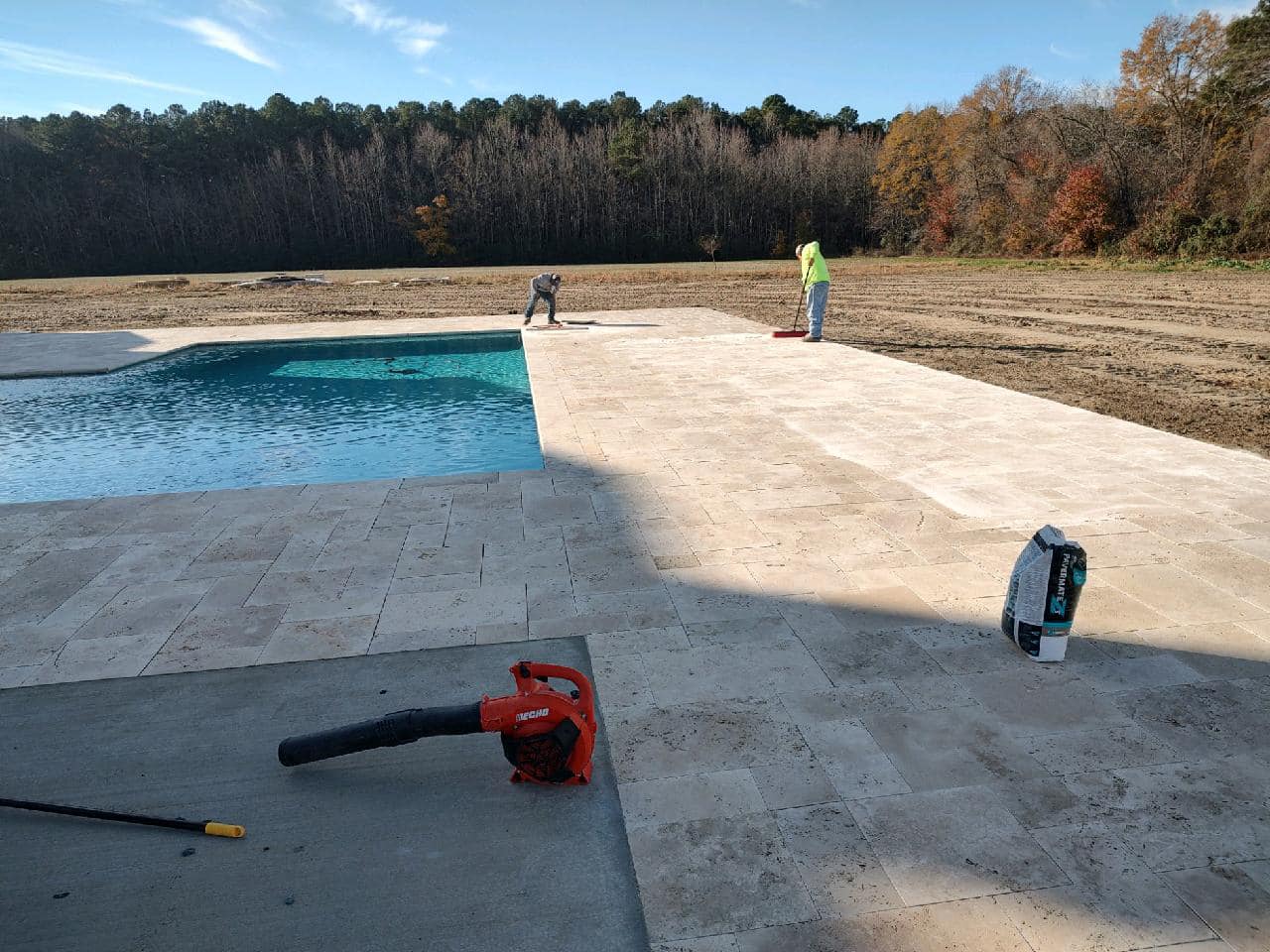
A Salt Pool Is Still a Chlorine Pool
A saltwater pool is chlorinated. It is not a chemical-free pool. It just makes its own chlorine instead of having chlorine poured into it.
Here is how it works. You dissolve ordinary salt (sodium chloride) in the water and run that water through a cell plumbed into the return line. The cell holds a stack of coated titanium plates with a low-voltage current across them. The current splits the salt, chlorine goes into the water, does its job, and turns back into salt. The same salt cycles around all season. It does not evaporate and it does not get used up, so once the water is charged you are only replacing what leaves through splashout, backwashing, and rain overflow.
It also does not get very salty. A salt pool runs around 3,000 to 3,500 parts per million depending on the manufacturer, and seawater is roughly 35,000. So a pool is about a tenth as salty as the Chesapeake outside, which puts it right at the edge of what you can taste. That mild salinity is what makes the water feel soft. The steadier chlorine level does the rest, instead of the swing you get from shocking on Saturday and running out by Wednesday.
What a Salt System Involves
Putting one on an existing pool is mostly a plumbing and electrical job. The cell goes into the return line after the filter and heater, a control board mounts on the equipment pad, a dedicated circuit runs to it, and the water gets charged with salt.
What it takes varies a good bit from pool to pool, and nobody can pin it down over the phone. It depends on the size of the pool, the size of the unit that pool needs, whether the equipment pad has room for the board or has to be reworked to make room, how far the power has to come, and what else on the pad is near the end of its life anyway. Two pools the same size on the same street can come out well apart for those reasons, so it takes a look at the pad.
The pieces are always the same, though: equipment and installation once, a one-time salt charge, and a cell that wears out and gets replaced.
People usually assume the salt is something you keep buying, and it is not. A 20,000 gallon pool holds roughly 167,000 pounds of water, and bringing that to about 3,200 ppm takes something like 530 pounds of salt, or 13 to 14 of the standard bags. You do that once. Salt is not used up making chlorine and it does not evaporate with the water, so after that you are only replacing what physically leaves the pool through splashout, backwashing, and rain overflow. Over a season that comes to a small fraction of the original charge.
The cell does wear out. The coated plates give up material as they work, and most of them last somewhere between three and seven years. Running yours at the lowest output that still holds your chlorine reading is what gets you the long end of that range.
What Gets Easier
The difference people notice is in the weekly routine, not on installation day.
A tab-fed or liquid-fed pool needs chlorine brought to it, continuously, all season. Somebody buys it, hauls it, stores it out of the sun and away from children, loads the floater or pours the jug, and does it again in a few days. Run out mid-July and the pool goes green while you go get more. All of that goes away. The generator makes chlorine on site out of salt that is already in the water and stays there, so what you keep buying drops to occasional salt for what splashed out, plus acid.
The chemistry gets easier too, not just the hauling. Chlorine made continuously at a low rate holds a steadier reading than chlorine dumped in twice a week. A tab-fed pool runs over-chlorinated for part of every week and under-chlorinated for the rest of it, and algae gets its opening during the under half. Steady output takes most of that swing out, which is why salt pools tend to look better between visits.
None of that means a salt pool takes care of itself, and anybody who tells you it does has not run one. Electrolysis drives pH up, so acid goes in on a regular schedule and more often than a tab pool needs it. Stabilizer has to be watched instead of topped up out of habit, for the reason in the next section. The cell needs cleaning. You end up doing less hauling and dosing and more testing and adjusting.
The rest of it is what got people asking in the first place. The water feels softer on skin. It does not smell like a public pool locker room, because that harsh smell people call chlorine is mostly chloramines, and chloramines build up when chlorine crashes and gets shocked back instead of being held steady. And there are no jugs or buckets sitting in the garage.
What Gets Harder
Three things that do not show up in the brochure.
Cold water stops the cell. Most units quit producing chlorine below about 52 degrees. That is fine for a pool that closes in October, but a salt system will not keep an early-spring or late-fall pool clean. You are back to hand-dosing in the shoulder weeks.
Stabilizer runs higher. Continuously generated chlorine has no defense against UV, so salt pools want cyanuric acid up around 60 to 80 ppm rather than the 30 to 50 a traditional pool runs. Cyanuric acid does not leave on its own. The only way it comes down is draining and refilling, so it has to be watched instead of topped up out of habit.
The cell scales. Calcium plates out on the electrodes, especially in hard water. Modern cells reverse polarity to shed most of it, but you should still expect to pull the cell and acid-wash it now and then. A scaled cell tests low for chlorine, and people chase that by adding more salt instead of cleaning the plates.
The Metal Question
This is where a badly specified salt pool shows up, usually about two years later.
Salt water is harder on metal than fresh water, and it is more conductive, so both direct corrosion and galvanic corrosion move faster. Anything metal in the water, at the waterline, or catching regular splash has to be picked for that.
316 stainless, not 304. The two look identical once they are installed, which is how the wrong one ends up in the ground. 304 stainless is the general-purpose grade and it pits in chloride. 316 has two to three percent molybdenum in it, and that molybdenum is what resists chloride pitting. On a salt pool, handrails, ladder anchors and their escutcheons, cable rail hardware, light rings, and every fastener within reach of splash should be 316, or 316L for anything welded. Taking 304 because it is what the supplier had on the shelf is how you get rust streaks running down a deck that is one season old.
Sacrificial anodes. A zinc anode plumbed into the line or attached at the skimmer gives the water something to corrode that is not your ladder, your light housing, or your heater. Zinc is less noble than the stainless and copper in the system, so it gives up material first. It is a small part that gets swapped out when it is eaten away, and anodes are standard on salt pools.
Heaters. If there is a heater on the system or one in the plan, the heat exchanger matters. A standard copper exchanger has a shorter life in salt water. Cupronickel is the version to ask about. Better to know that going in than afterward, because swapping a heater later means opening up plumbing that was just finished.
Fence and gate hardware. Easy to forget and quick to fail. Hinges, latches, and screws on a pool barrier sit right where splash and salt-laden air land. Same rule as above: 316 or a quality powder-coated aluminum, not plain galvanized, and not whatever came in the box.
Vinyl liner pools need a closer look. If the pool has steel wall panels behind the liner, salt water becomes a problem the day the liner springs a leak. Water behind the panels is bad enough in a fresh pool and worse with salt in it. On an older liner pool, the wall construction is the first thing to find out. A fiberglass shell does not have that exposure, which is part of why fiberglass and salt go together, and why the fiberglass pools we install come up so often in this conversation.
Pumps
The pump side of this worked out well, mostly by accident.
Since the federal efficiency rule took effect in 2021, most new dedicated pool pumps above a modest horsepower are variable speed. You largely cannot buy a new single-speed pump for a pool this size anymore, and that suits a salt system well.
A salt cell only makes chlorine while water is moving through it. With a single-speed pump you either run short hours and make less chlorine, or run the long hours the cell wants and burn a lot of power doing it. A variable-speed pump gets you out of that. Power draw falls off much faster than speed does, so a pump turned down to half speed uses a small fraction of the power it pulls at full. You run it long and slow, the cell produces steadily all day at a lower output setting, the water turns over gently, and total power use drops even though the pump runs longer hours. That lower output setting also stretches the life of the cell plates.
Two details matter on the install. The cell needs a flow switch wired so it cannot energize without water moving through it, which protects the cell and keeps gas from building up. And the low speed has to be set high enough to actually trip that switch, because a pump dialed down too far will run quietly all afternoon making no chlorine at all.
Everything Around the Water
Everything up to here happens at the equipment pad. The rest of it happens out in the yard, and that is usually the bigger half: the deck, the walls, the fence, the shade structures, and the grading and drainage under all of it. The trade calls that hardscaping, which is a word almost nobody outside the trade uses. It means the built parts of a landscape, the ones made of stone, block, concrete, and timber instead of plants.
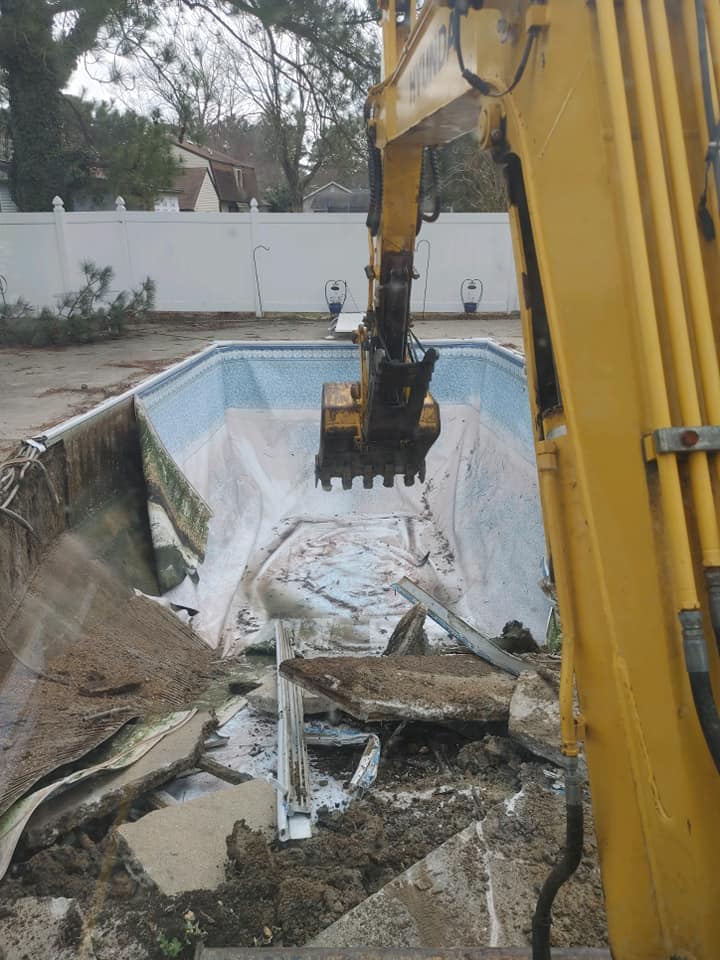
Excavation and the water table. Delmarva is sandy loam over a high water table, and on plenty of Shore lots you hit water within a few feet of the surface. That affects the dig several ways: whether the hole needs dewatering while the shell is set, where the spoil goes, how the surrounding grade gets rebuilt so runoff moves away from the pool instead of into it, and whether a hydrostatic relief valve is warranted. It is also why the shell gets backfilled properly instead of shoved back in with whatever came out of the hole. That is excavating and grading work, and how well it is done decides whether everything built on top of it stays put.
Backfill and drainage stone. Native sandy loam holds water against the shell and settles unevenly under a deck. Clean angular stone does neither, which is why #57 washed stone goes in instead. The fines are washed out of it, so the voids stay open and water moves through rather than sitting there, which is what you want against a pool wall and under a deck edge. The same material goes into the French drains and dry wells that carry deck runoff and backwash somewhere it can actually go. The full material list, weights per yard, and a tonnage calculator are on the aggregate delivery page, and the drainage design runs through excavating.
The deck, and why salt changes the material conversation. Salt water lands on the deck constantly. Shore winters cycle above and below freezing all season instead of staying frozen. Salt in the surface of a concrete slab pulls in moisture and drives more freeze-thaw cycles through the top quarter inch than the slab would otherwise get, and the surface scales and flakes off. It is the same thing that chews up road-salted sidewalks, except it happens on your deck every summer.
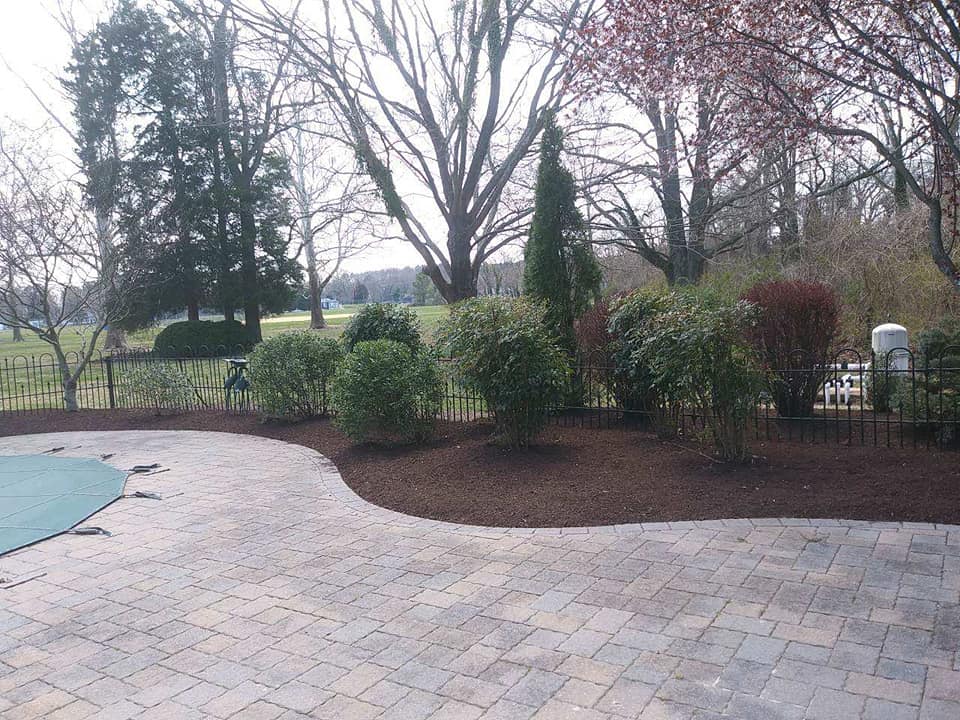
That is why we lean toward pavers around a salt pool, for the same reasons pavers win on driveways here. They flex with ground movement instead of cracking against it, individual units can be lifted and reset if a section settles, and the deeper compacted base and open-graded bedding layer under them give splash water somewhere to drain instead of ponding. If the deck is going to be poured concrete, it needs to be air-entrained, jointed properly, and sealed on a schedule somebody actually keeps. The material logic is laid out in the driveway surface guide, and the build detail is on the hardscaping page.
One more thing on stone selection. Some natural stone and some mortar joints show salt efflorescence, the white bloom you get when salts migrate to the surface and dry there. It does not hurt anything, but it keeps coming back. Ask how a given stone behaves in a salt application before it goes down around the pool, not after.
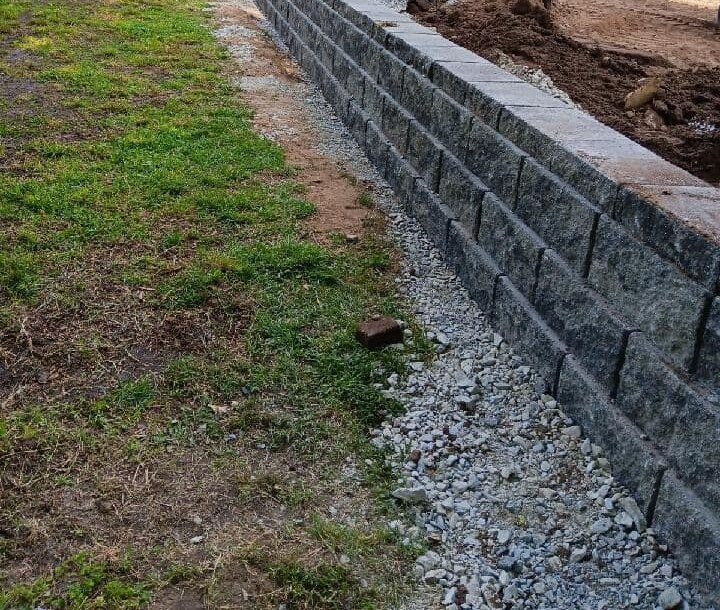
Retaining walls and grade. Pools want a level pad, and Shore lots are rarely level where the view is. A wall near a pool holds soil back, but it also decides where water goes, so it needs drainage stone and pipe behind it and a compacted base under it. Get that wrong and the wall leans into the pool deck a few winters later.
Fencing
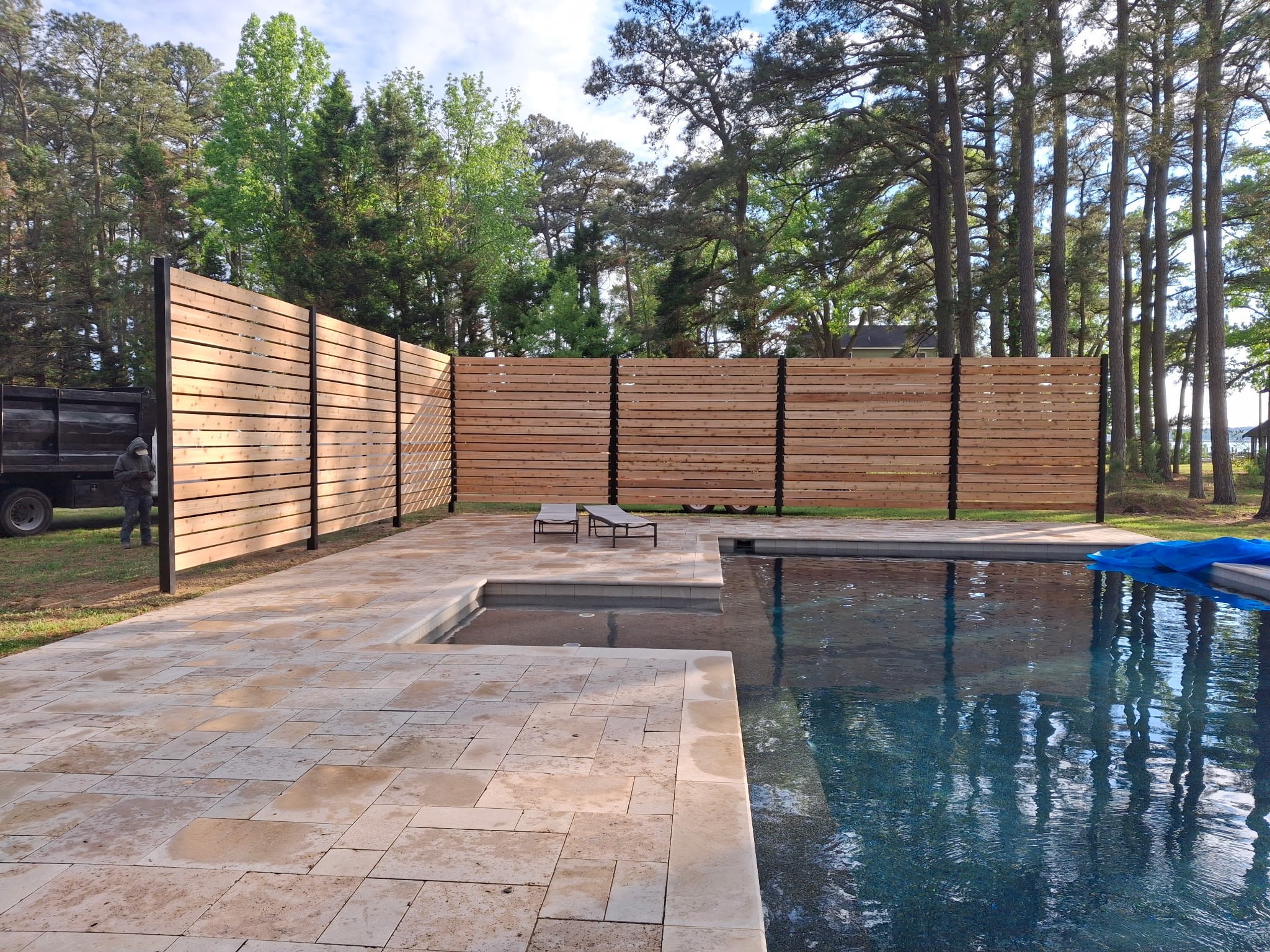
Any in-ground pool needs a barrier. Most Shore counties require one, generally at least 48 inches high, with a self-closing, self-latching gate that swings away from the pool and a latch set high enough that a small child cannot reach it. Your county permit sets the exact spec, so read it before you buy fence.
After that it comes down to material and hardware. Aluminum picket keeps a view open and does not rot. Vinyl and board fencing screen a neighbor. Planted screening with arborvitae or Leyland cypress looks like part of the property instead of something bolted onto it, though it takes a few seasons to fill in and it will not meet the code requirement by itself, so it usually goes behind a permitted barrier rather than instead of one.
Near a salt pool, post setting and hardware are what matter. Posts set shallow in wet Shore soil heave, and a heaved post throws a self-closing gate out of alignment, so a barrier that passed inspection quietly stops latching. Hardware follows the 316 rule from above. Details on both are on the fence installation page.
Pergolas and Pavilions
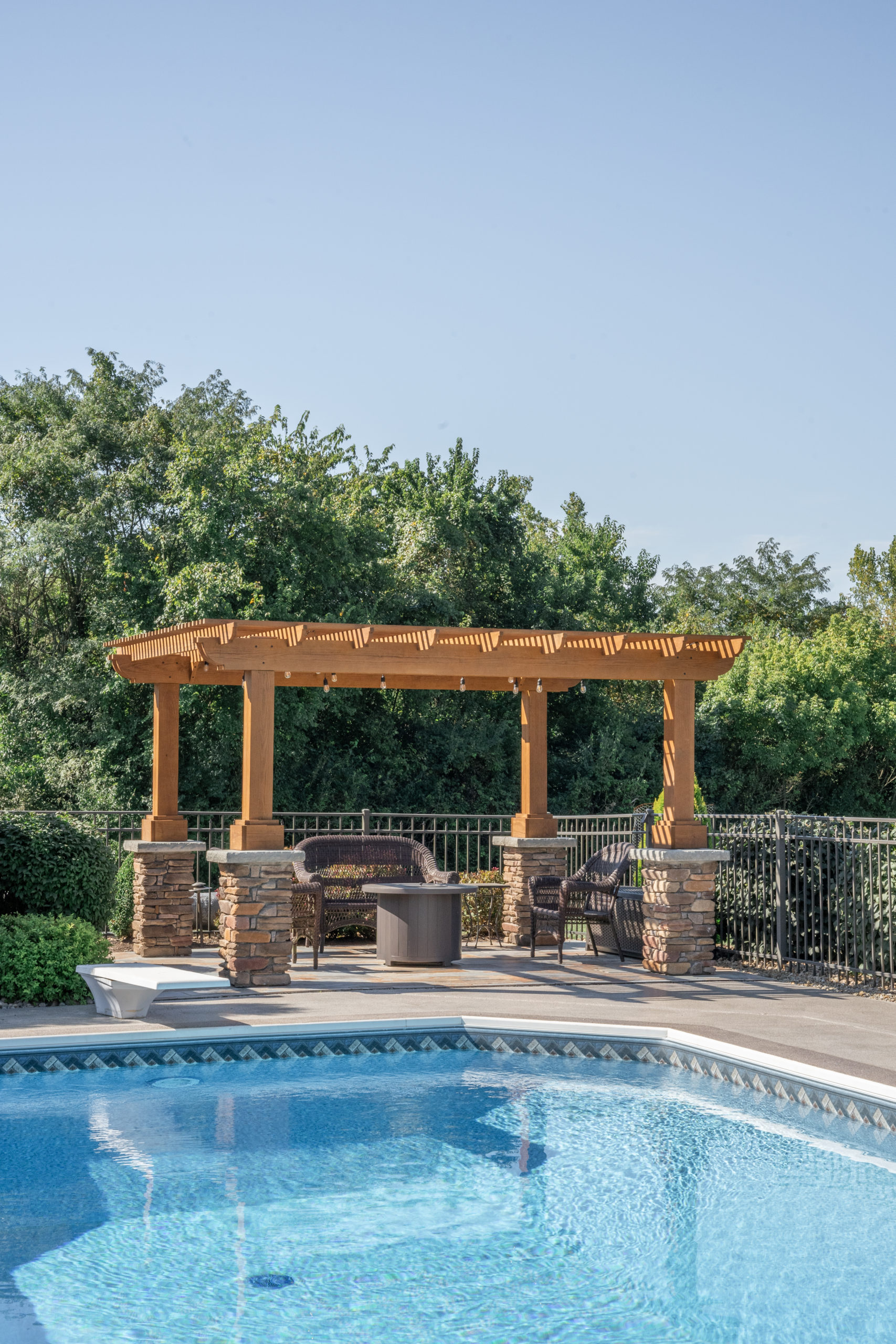
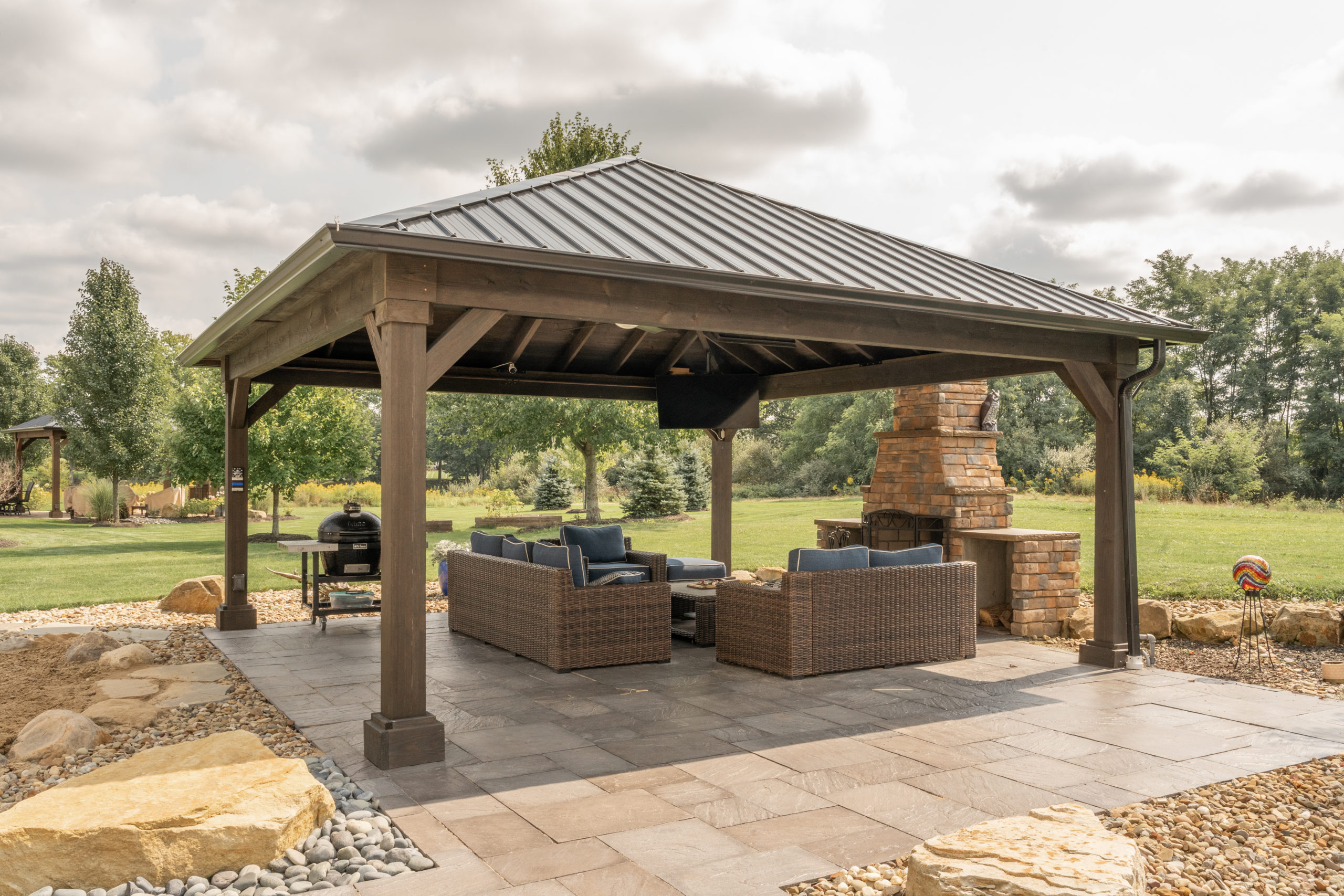
Without shade, a pool deck in July mostly gets looked at through the window. An open pergola breaks up the sun over a seating area while still letting air move, which matters more here than it does inland, because the breeze is often the only thing making mid-afternoon tolerable. A pavilion with a solid roof gives you somewhere that still works in a rain shower and stays useful into the fall.
Two things to watch near a salt pool. Fasteners, brackets, and post bases catch airborne salt, so the corrosion rules do not stop at the water’s edge. And the footings deal with the same wet ground and the same wind load as everything else on the property, so they get designed rather than guessed at. Options and materials are on the pergolas and pavilions page.
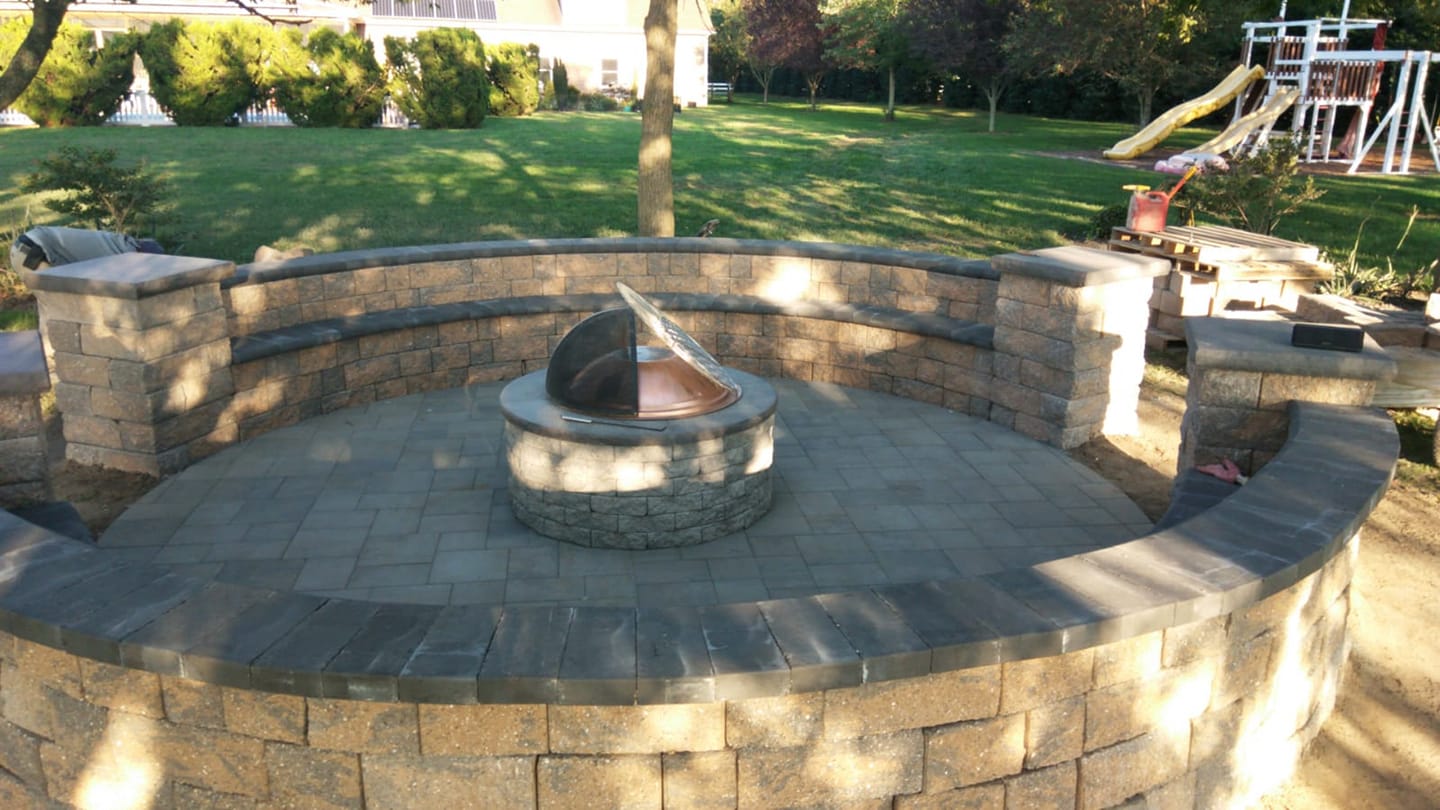
A firepit set into the deck gets you a couple of extra months on either end of the season, and it is much easier to build while the deck is going in than to cut into it later.
What Decides Whether It Is Simple or Complicated
On some pools a salt system is an easy addition. On others it drags a list of other work behind it. These are the things that tell you which one you have.
- What the pool is made of. Fiberglass and plaster are fine. Vinyl liner over steel panels is the one to check first, for the reason above.
- What metal is in and around the water. Ladder, rails, light rings, fasteners. Anything already showing rust is 304 or worse.
- What the heater exchanger is. Copper has a shorter life in salt water than cupronickel does.
- How old the pump is. A single-speed on its way out is going to want replacing anyway, and a variable-speed is what makes a salt cell run well.
- What the deck is. A concrete deck that is already scaling will scale faster with salt landing on it.
- Where the deck water goes. If it runs toward the house or just sits, that is a problem with or without salt, and salt gives it a second reason to matter.
- Whether the barrier meets current code. Any permit pulled on the pool tends to bring the fence into it whether you planned on that or not.
Where We Come Into It
Our half of a pool is everything around the water: the excavation and grading, the drainage, the deck, the fence, and the structures. Salt changes what those get built out of, which is the reason we pay attention to it at all.
We do not put salt systems on existing pools. That is pool service work, and a pool company is who you want for the equipment side of it. We build new pools, and we build everything around a pool you already have.
So when we walk a property that has a pool on it, this is what we are looking at. What the deck is and whether it is failing or fine. Where water sits after a hard rain and where the deck runoff ends up. Whether the fence is current, and what the gate hardware is made of. What is holding the grade, and whether it has started to lean. And whether this is just the pool area or the year the whole back of the property gets sorted out.
That last one changes the order of everything else. Excavation, deck, fence, and structures done as one project fit together better than the same work split across four separate calls over five years. The heavy equipment tracks across the yard once instead of four times, the grades get planned as a whole so the deck drains where the drainage was actually built to take it, and nothing has to be cut back out later to make room for something nobody knew was coming.
Marshall Property Management. Cambridge, Maryland. Pools, pool decks, hardscape, fencing, shade structures, excavation, and drainage built across the full Delmarva Peninsula. Maryland’s Eastern Shore, Delaware’s Sussex and Kent Counties, Virginia’s Accomack and Northampton Counties.
Fiberglass Pool Installation · Hardscaping · Excavating · Aggregate Delivery · Fence Installation · Pergolas & Pavilions · Request a Free Estimate or call (443) 205-4415