From a distance, mowing a solar site looks like the easiest acreage work there is. Flat ground. No trees. No beds, no edging, no homeowner standing in the driveway. Just grass and a lot of it.
Then you drive in the gate and start counting the things you are not allowed to hit.
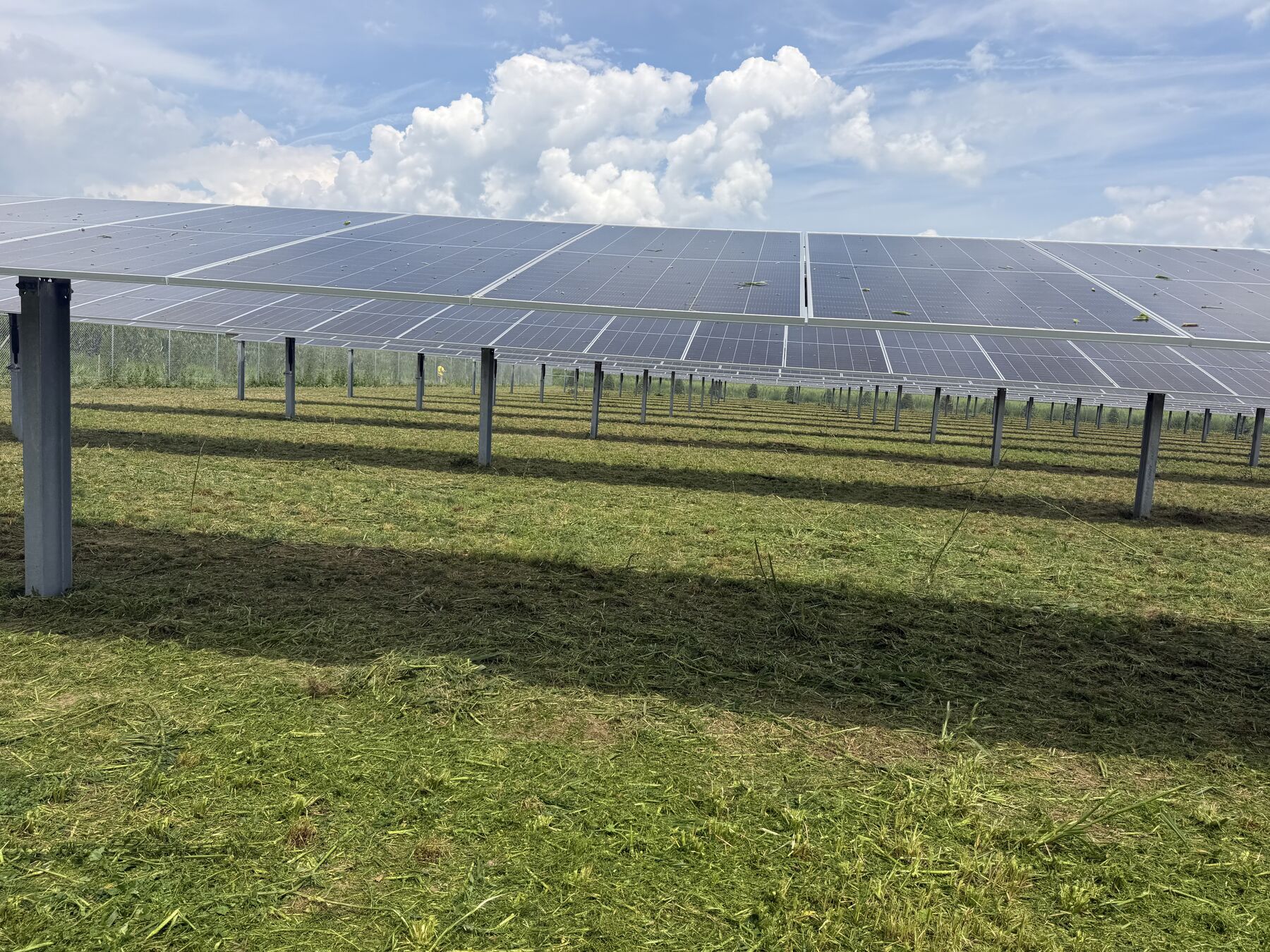
The obstacle count is what decides the job
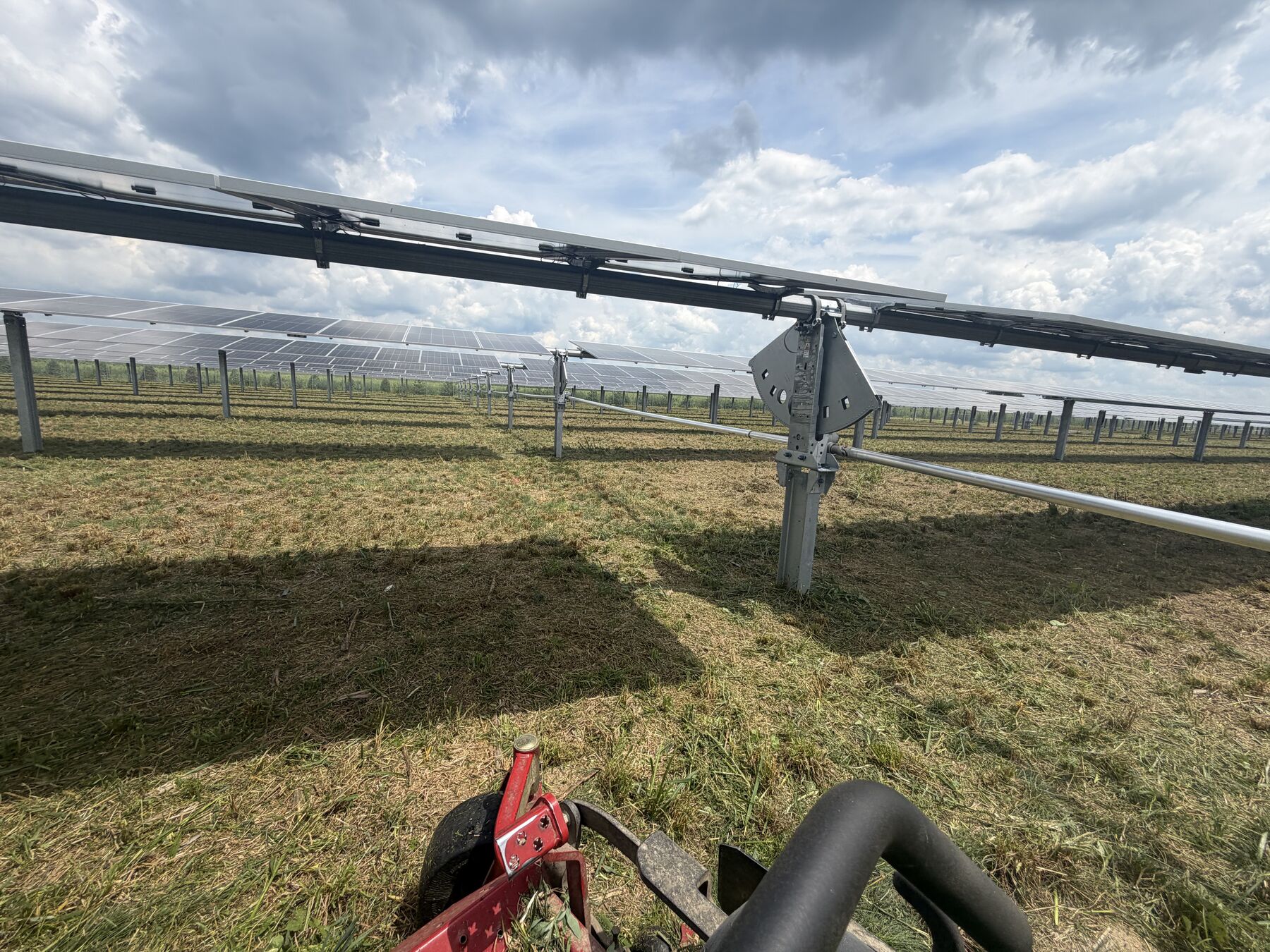
A hay field has nothing in it. A solar site has a steel pile driven into the ground every few feet, in rows, for as far as you can see. On a tracker site each row also carries a torque tube with bearing assemblies and dampers hanging off it at operator height, plus grounding lugs at the base of the posts, conduit coming out of the ground, DC wire runs clipped along the underside of the racking, and combiner equipment on pads scattered through the array.
Every one of those is either something that stops the machine or something that costs the site money when you break it. A cut wire is a string offline until somebody troubleshoots it. A bent bearing bracket is a tracker row that stops following the sun. The mowing pattern is not chosen for efficiency, it is chosen for what the machine can clear.
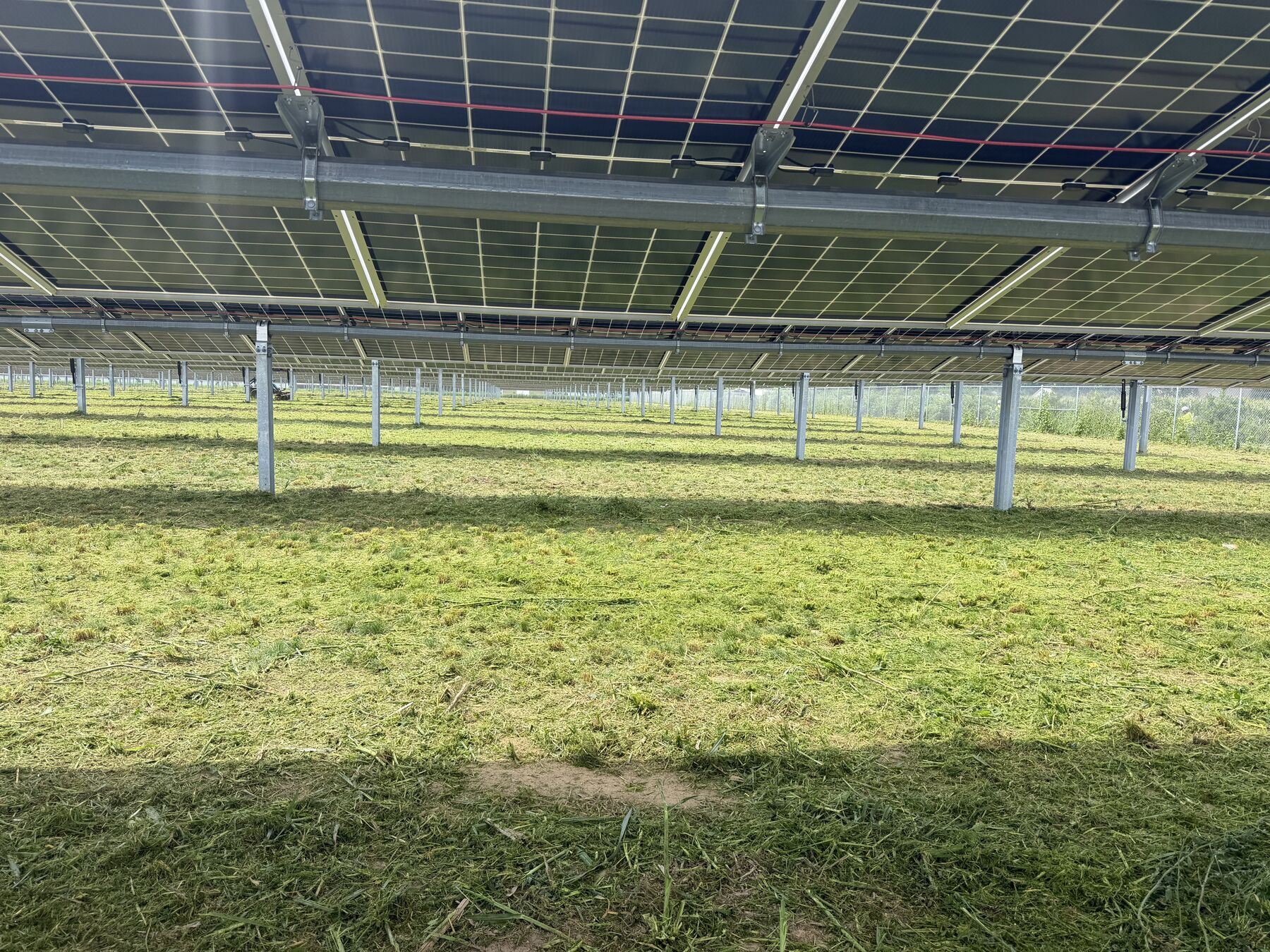
That photo is taken from underneath. On a single axis tracker the panels rotate through the day, so the clearance under the low edge of a row is not a fixed number. It is high at noon and low in the morning and evening. Work the low rows in the middle of the day and you get a working height. Show up at five and the same row is sitting on your roll bar.
Which way the clippings go decides how you cut
Out in an open field nobody thinks about which way the clippings go. Next to several thousand sheets of glass, it is the first decision.
A mower deck throws whatever it picks up, and it does not distinguish between grass and the piece of stone that came in on a tire. Thrown debris into a module is a cracked panel, and a cracked panel is a replacement, a site visit from somebody else, and a conversation nobody wants to have. Cutting near the rows means the discharge is aimed away from the array or the deck is closed and mulching, and it means walking a row before cutting it if the site has had equipment traffic.
There is a smaller version of the same problem. Clippings that land on panel faces sit there, shade cells, and hold dirt against the glass until enough rain comes to move them. Nobody is going to bill you for that, but it is a production loss you caused and it is avoidable by cutting in the right direction.
The grass has a job on this site
This is the part that separates solar work from ordinary commercial mowing.
On a solar site the ground cover is usually not decorative. It is the permanent stabilization for a site that was stripped, graded, and driven all over during construction, and it is very often written into a stormwater or sediment control approval. That vegetation is what keeps the soil from moving into the ditches, the outfall, and eventually whatever the site drains into. On the Shore, that is a tidal creek within a mile or two of almost anywhere.
Two things follow from that.
You do not scalp it. Cutting a permitted site down to bare dirt in July defeats the reason the cover was established, opens the ground to erosion in the next thunderstorm, and can put the site out of compliance. There is a height range that keeps the panels clear and the ground held, and the cut is set to it.
You do not rut it. A heavy machine on saturated Delmarva soil leaves tracks, and tracks between rows become channels the first time it rains hard. On a permitted site a channel is not cosmetic, it is a repair with a seeding and stabilization requirement attached. Waiting three days for the ground to firm up is cheaper than fixing what you tore up by not waiting.
Marshall holds the MDE Erosion and Sediment Control Yellow Card, which is the reason we look at a solar site as a stabilized surface with equipment on it rather than a lawn with obstacles in it.
Why it gets cut at all
Vegetation on a solar site is managed for four separate reasons, and only one of them is appearance.
Shading. Grass that reaches the low edge of a module shades the bottom cells. A shaded cell does not just lose its own output, it can drag the whole string it sits in. Grass tall enough to touch the panel is grass that is costing the site production, which is why the cut height on a solar site is set by the low edge of the array and not by what looks tidy.
Fire. A solar site is a field of dry fuel with electrical equipment in it. Heavy dead thatch under an array in August is a risk the site owner is carrying whether they think about it or not.
Access and inspection. Operations crews walk these sites looking at connections, tracker function, and fencing. They cannot inspect what they cannot see, and neither can we.
The fence line. Vegetation growing into a security fence damages the fabric, blocks the inspection line, and makes a climbable ladder out of a barrier. Both sides of the perimeter get cleared, which on most sites means coordinating with whoever owns the ground outside the fence.
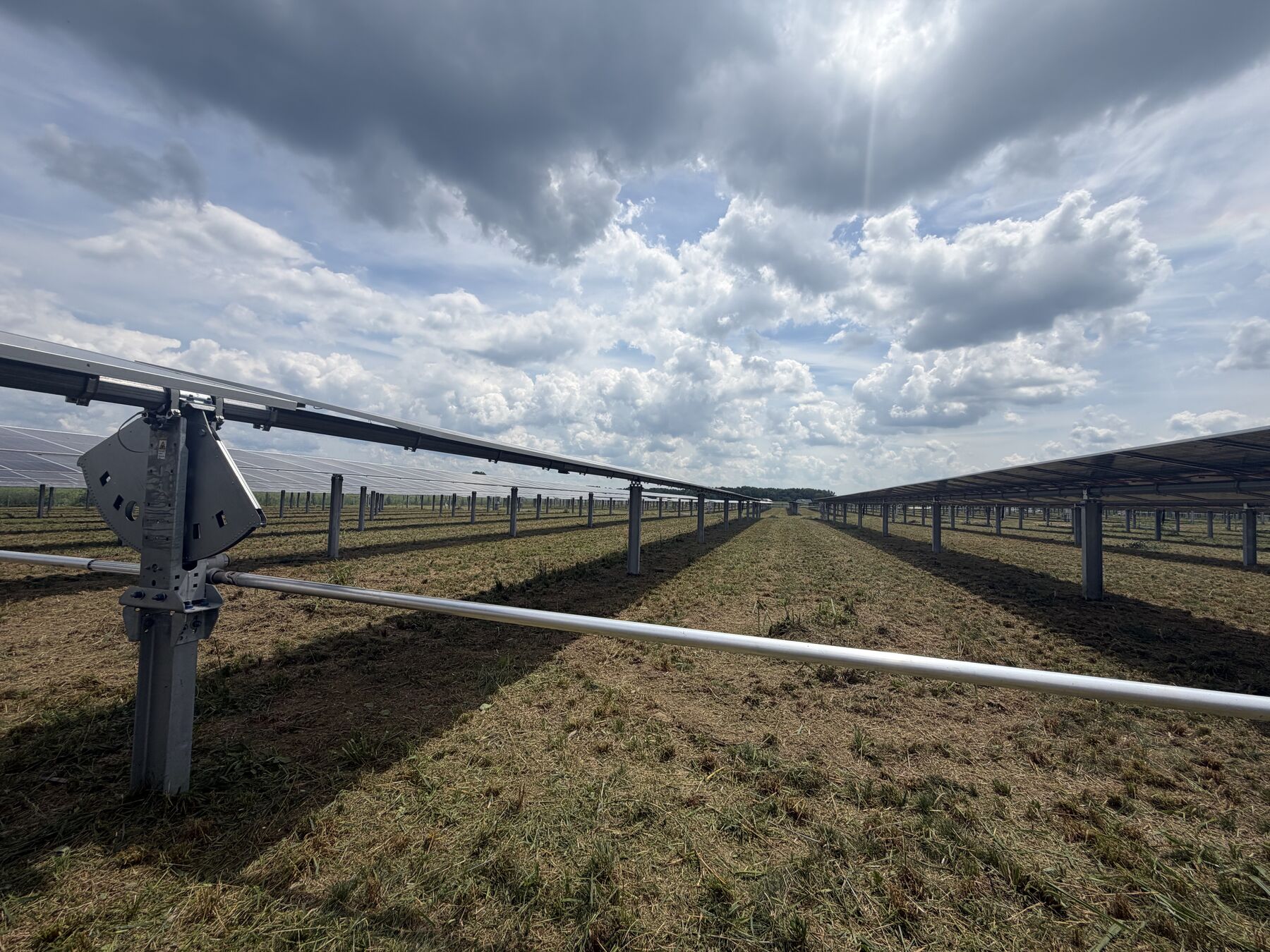
Mowing is not the only vegetation decision
Two things run alongside the cutting on every solar site, and both cost more when they are deferred.
The first is selective weed control. Because the ground cover is doing a job, you cannot spray a solar site bare, but you can take the broadleaf and woody invaders out of the stand and leave the grass. Locust and sweet gum seedlings that come up in a fence line or between rows are cheap to kill at two years old and a clearing project at six. The strip along the fence itself is usually treated so the mower is not trimming against the fabric.
The second is the road in. A solar site is reached by one gravel lane, and every service truck, delivery, and inspection arrives on it. Weeds rooting in that stone trap fines until the surface stops shedding water, and shoulders that build up from years of grading turn the lane into a ditch that holds rain on the running surface. Both are cheap to stay ahead of. Neither is cheap to fix after two wet seasons.
The screen counts too
Most solar sites on the Eastern Shore got approved with conditions, and one of the common ones is a vegetative screen along the road or along a neighboring property. That planting is not landscaping in the ordinary sense. It is a permit condition with survival requirements, and dead plants in the screen line are a compliance item, not just a gap in the hedge.
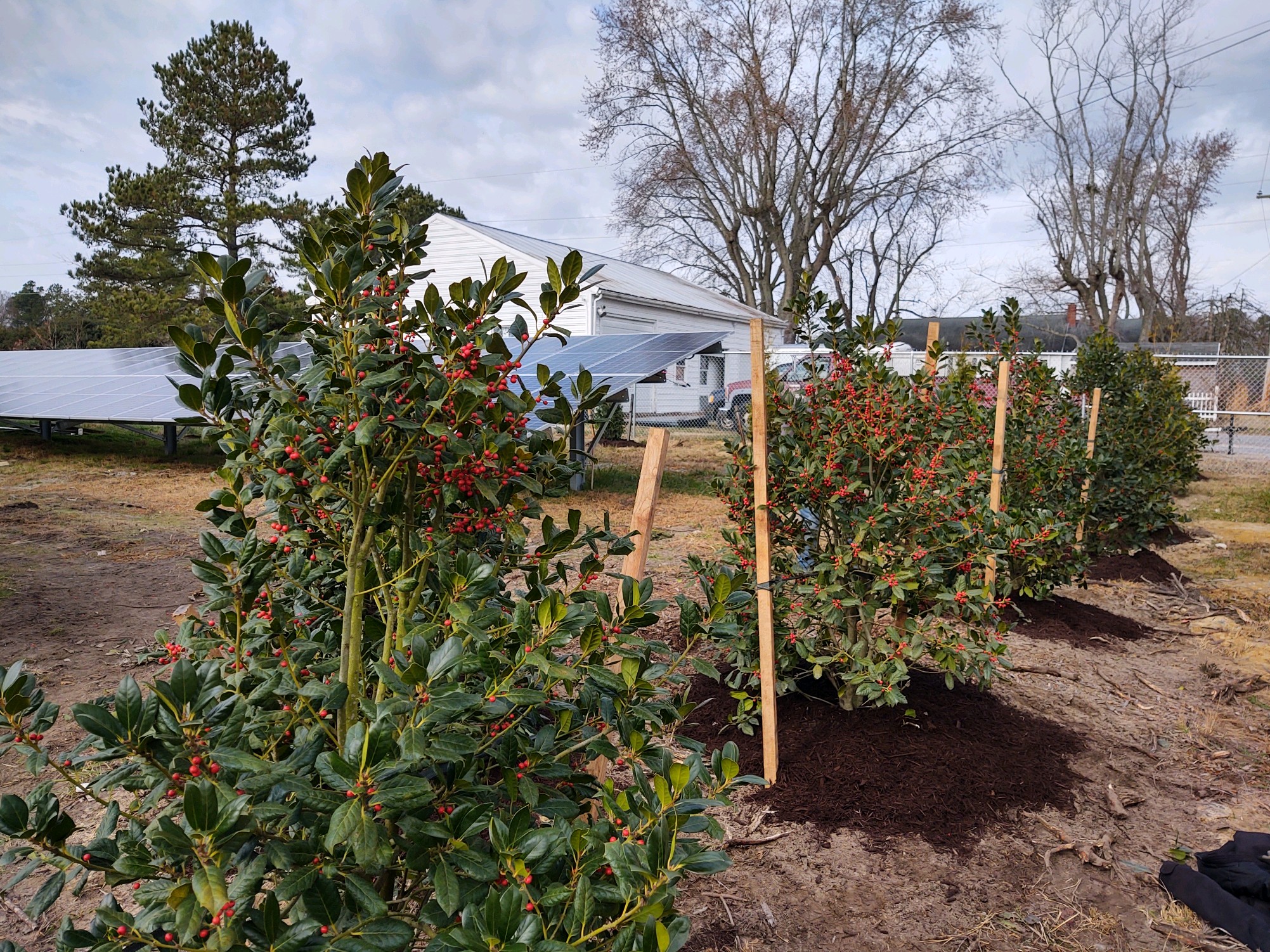
We have installed those screens and we maintain them, which means watering through establishment, replacing losses, and keeping the mowing off the root zones. It is worth knowing which of your site’s plantings are voluntary and which are conditions of approval, because they get treated differently.
What we tell owners and operators
Solar sites tend to be priced by somebody in an office looking at an aerial, and then mowed by whoever bid it, and the gap between those two facts is where the damage happens. A few things are worth settling before a season starts.
Cut frequency should be tied to growth, not to a fixed number of visits. On Delmarva, spring growth can require a pass every three weeks and August can go six. A contract that sold you eight visits will either shortchange you in May or bill you for cuts you did not need in September.
Somebody should be documenting the site. We fly it, which gives the owner a repeatable aerial record of vegetation coverage, bare areas, standing water after a rain event, and screen survival. On sixty acres that is the only practical way to see the whole thing at once.
And the crew should know what the equipment is before they arrive, not after.
Marshall Property Management maintains solar generation sites, farms, industrial yards, and commercial campuses across the Delmarva Peninsula. Full scope on the large property maintenance page.
MDA Pesticide Business #27327 · Applicator #42337 · MDE Erosion & Sediment Control Yellow Card · Licensed in MD, DE & VA · Cambridge, Maryland
Request a Site Walkthrough · Large Property Maintenance · Farm Maintenance